Wednesday, January 14, 2015

Regional Roads: Why Regional Roads? (Part 1)

Devolution nationwide continues to gain steam as the political environment favors increased local control.  Almost no state has added any new highway mileage in decades, cities and towns are taking roads from counties, and the number of local governments continues to increase creating less and less accountability for how roads are maintained.  The purported benefits of this are debatable, but the reality is that placing more and more authority for roads on a high number of small counties, cities and towns amounts to being a very popular bad idea.  It creates a bigger structural problem to solve a smaller cost problem, which is that states lack the resources with current tax rates to manage larger state road systems.  

All states and most territories have at least some locally maintained roads.  Just because they are common does not mean they really work all that well.  It is common knowledge that local governments are just not going to produce the same results as the state does in terms of standards and frequency of maintenance, and the real reason that states hand off roads to counties is that they want them to be responsible for the cost of construction, including minor resurfacing.  That doesn't mean that they are also prepared to take on technical operations like traffic engineering nor do they have the resources to perform traffic studies or maintain roadway safety features as often as the state.  They do not have the economies of scale, and a small jurisdiction cannot justify an expensive cost for equipment, materials, and storage for larger roadway operations making them inefficient by default.  Unfortunately, increasing local control in terms of service delivery has very mixed results with no real alternative being offered at present.  It should be noted that there are success stories are rare and usually in the case of:

  • Wealthier cities breaking off of very high population counties (usually with a population of around 25,000-45,000)
  • Very large population, mostly consolidated counties regaining control of their own roads
  • Consolidated city-counties (popular primarily in the South)
  • Counties and larger cities who contract with the state to maintain state routes 


In these examples, note the following: the wealthier cities have a large tax base for a small geographic area and are depriving the larger region the economies of scale and better standards.  They also still have the issue of having "the foxes guarding the henhouse" in that oversight is low to non-existent.  As to large population counties with broad powers, these are relatively rare.  Most high population counties are carved up into numerous cities and towns that cut into their landlocked tax base, and counties like Los Angeles County where the county provides road maintenance on behalf of most cities are also uncommon.  Counties as large as states that can act as states in this manner.  Less than 50 counties in the entire nation have populations exceeding a million residents, and of those the amount that have the purchasing power and responsibility of states can be counted on one hand.  Fairfax County in Virginia doesn't even operate a county road system relying on VDOT for maintenance although they assist heavily in planning and funding construction projects.  Consolidated city-counties, while they do provide better efficiency and lower costs, are still just a larger city and still have many of the same problems of larger cities.  Because of their status, they are unlikely to contract with neighboring jurisdictions in the suburbs due to the fear that those jurisdictions might be annexed into the city.  While Davidson County, merged with Nashville, has very high standards for its roads, those benefits do not stretch to neighboring counties or municipalities in greater Nashville.  They stop cold at the county line in every direction.  Other consolidated city-counties are not as effective, and their populations/tax bases are far below Nashville.

Noting these exceptions, it is still important to point out that counties, townships and municipalities by their very nature almost always both duplicate services and raise basic costs.  The only way they avoid this is by cutting corners.  The easiest way to cut corners is by maintaining roads below regulation, deferring maintenance on anything deemed "non-essential", avoiding any traffic studies on their roads that might increase liability, and not having any engineers hired as either staff or consultants to oversee their roads.  This is unethical, but in many states it is legal.  This way, nobody can be held accountable for shoddy workmanship or substandard roadway conditions since technically no engineering was involved.  Wealthier jurisdictions ultimately cannot avoid liability and do begin to move away from this practice, but not always!  This is amplified not only because the state operates a separate system within the same county but also when other counties and cities are in close proximity spreading the available tax base very thin.  

It is important to note that counties cannot grow to assume more responsibility to enhance their tax base nor services.  While cities can grow, it is not often that a city is capable of growing large enough to provide even county-level services.  The average city or town usually has a population of between 1,000 and 5,000 residents, so the comparison to a major city such as New York, Atlanta or Dallas would be disingenuous.  What if this barrier was removed for cities, counties and townships to provide certain services?  What if these geographically constricted cities, counties and towns could turn to their neighbors and start shaking hands to combine resources in such a way to provide higher standard, more cost-efficient and better maintained roads than they currently can within the confines of their geography while still maintaining their local autonomy?  The regional roads plan is how that can be done.


Moreover, it is not at all beneficial when the responsibility for roads transfers from the state to a low population county, city or town: especially when state-level financing must be divided across a very large number of jurisdictions.  The stated benefits of local control are simply not realized when a technocratic state agency reverts that responsibility to a large number of small political entities with the funding pie too small to assure that the purchasing power, financial flexibility or technical expertise is in place to provide an equivalent service to what the state is otherwise able to provide.  LTAP (Local Technical Assistance Program) is also not working, because it provides no actual supervision, does not guarantee access to engineering services, and it is not raising the standards high enough under the current structure nor promoting uniformity across all jurisdictions.  More oversight is needed.  If the state is not going to relieve counties and small municipalities of what they are unable to do well, another way is needed.

A NEED TO UPDATE THE NORTH CAROLINA PLAN


First, it should be noted that state populations and their subsequent road networks are significantly larger than they used to be.  When the Brookings Institute proposed consolidating entire county road networks under state control in the 1930's, the nation's public highway system was still in its infancy and the US population was far lower.  There were very few multi-lane highways, most roads were still unpaved, numerous bridges and road segments were private toll roads, and state highway systems nationwide were not even a decade old.  North Carolina was the first state to adopt this plan.  While the North Carolina plan has been successful, the system has not been free of problems.  The reality is that the states that embraced the North Carolina plan have either abandoned it (such as Maryland) or are struggling to balance modern transportation demands with the maintenance and improvement of smaller local roads (such as Virginia).  Inter-regional conflicts for road funding further endanger such systems with accusations that the entire road network in one region is being cheated out of road funding in favor of another in lieu of a few major routes.  State DOT's are frustrated that they have to maintain local roads when it means less money to cover large-scale construction projects.  Today, only four states fully adopted the North Carolina plan and only 20% of states have adopted a system that fully relieves counties and low population municipalities of maintenance of federal-aid eligible roadways.  With shrinking federal-aid, high inflation, state governments leery of raising taxes, and rising construction costs, every one of these larger state road systems are just one election away from a sudden move to dump all of these roads back onto local governments.  What the local agencies need is a counter proposal and backup plan if they don't want to end up like 80% of states with a huge responsibility for both streets and highways without the resources to maintain them right.

On top of that, two of the four states that have adopted this special state-controlled county road system either partially or in whole have seen a huge increase in population from when the systems were established.  North Carolina had 3 million residents in 1931.  Today that population is approaching 11 million.  Virginia, who established the similar Byrd Road Act in 1932, had a population of 2.5 million when the system was created.  Today, that population has exploded to 8.7 million.  However, despite both states having more than tripled in population, that population tends to be clustered in a few major metropolitan areas.  Rural areas in both states have been growing slowly or losing population in favor of these larger metropolitan areas thus leaving these counties, cities and towns increasingly strapped for funds.  This means that rural areas need to be looking beyond their boundaries to create efficiency, offer a full scope of services, and provide high quality public roads.  Even urban areas by and large are likewise being very constrained by balancing local needs with the needs of the entire state: especially when metropolitan counties are carved up into many smaller municipalities.  

The paradox of the urban areas is that the push for self-governance increases with the population, so the economies of scale needed for good roads often do not materialize.  The Virginia and North Carolina systems also excluded larger cities meaning that cities that actually do need the benefits of centralization are unable to join the secondary road system.  Obviously, the state does not want to be responsible for 100% of the roads, but let's not forget that in both systems the state both owns and maintains these roads in contrast with Puerto Rico where the territory maintains 100% of the roads but only actually owns around a quarter of that meaning that they rely on local funding for other roads that they simply expand state-level services onto.  That division between jurisdiction and maintenance is an essential component of a regional roads plan where consolidated efforts do not require ownership or a shift in funding to a whole other level of government.

It is also no surprise that the North Carolina plan states are also increasingly upset by the lack of funding and action on a state level for their congested, outmoded roads.  It should be pointed out, however, that one of the four North Carolina Plan states is not having the difficulties that Virginia and North Carolina are having.  Delaware, one of the smallest states in the nation, is made up of only three counties.  Functioning on a compact level, Delaware has been able to maintain tremendous efficiency by keeping state control of both major roads and county roads partly because it is still close enough to the center of government to be manageable.  With no competing regions or large swaths of rural area far from the state capital, it is probably the most successful example of the North Carolina plan.  It obviously helps that the entire state of Delaware is in effect one region.  The only difference between Delaware's road system and a regional system is that the DelDOT maintains both highways and county roads vs. a regional system where the three counties would operate a statewide joint operation separate from DelDOT that could include contracting with cities and towns but would not include highways.


States like Virginia have become financially and structurally overwhelmed with the costs of maintaining local roads under a single state agency.  Perhaps dividing that responsibility into regions will help restore the efficiency that Virginia's unique road system was designed to do.

Local control advocates in their defense of devolution cite examples of larger population jurisdictions that do a good job while ignoring the fact that the majority of local governments are very low in population and are never going to measure up.  It is disingenuous to compare Nashville-Davidson County in Tennessee to a rural county in the state like Bledsoe.  It is apples and oranges.  With a population of over 700,000 residents, the agency functions like a state within a state as it should while Bledsoe with less than 15,000 residents is never going to see the results of Nashville unless the county grows by almost 5000% and it is consolidated with its only city, Pikeville.  Naturally, this is something that is not likely to happen anytime soon, if ever, even though it is a growing county.  Even though statewide funding is more than adequate overall, the 95 counties that make up Tennessee are far too numerous to provide the quality and consistency that residents of Nashville-Davidson County enjoy.  What if the benefits that Nashville-Davidson enjoys were expanded into the entire metropolitan region of Nashville or beyond?


A sharp decline in road quality is observed here as Ridge Road in Nashville-Davidson County crosses into Cheatham County.  Cheatham County has a population of under 40,000 compared to Davidson's 600,000.  However, both are part of the Nashville MPO (Google Street View image).

Local control advocates will go further to state that this is simply an urban-rural divide where it should just be accepted that rural areas have less money and that things will improve as the population catches up, but how much population does it take?  A county with 11,000 resident is not likely to bloom into a county with 100,000 residents any time soon, and that is usually the threshold necessary for a county to be effective at creating a road maintenance that is capable of meeting professional engineering standards unless such a county is able to normalize its costs through contracting with a state or other outside jurisdictions.  Major road safety deficiencies can also be found on the local roads in much higher population counties such as those surrounding Nashville as is demonstrated by the photo above.  Regardless, Tennessee DOT is not interested in assuming local responsibility for roads even if the counties and cities paid them for the privilege.  In fact, local agencies being able to voluntarily pay state agencies to provide routine maintenance services on locally-owned roads and streets has rarely ever been successful.  The few times such programs were enacted they were typically short-lived.  It was always a good idea, but the states themselves saw no benefit in stretching their resources to cover lower classification roads, and they were able to successfully convince people that "too many roads" was a bad thing as if those roads were just garbage that could all just be thrown in a dumpster.  In terms of how some local agencies have kept them up over the years, they essentially did become garbage.

Instead of waiting for perfect circumstances, action needs to be taken.  Public safety should not be jeopardized with local accountability suppressed just to divide road responsibility based on an inefficient and archaic government structure laid out in the days of horse and buggy.  The conditions present in the 1930's with smaller local governments that led to the North Carolina Plan are still present today, but the increase in population has made it a major factor in fewer areas than the 1930's or even the 1980's.  Nevertheless, weak accountability and local political whims continue to make locally-maintained roads a sketchy proposition.  What has changed since the 1930's the most, however, are the increasingly powerful metropolitan areas competing with rural areas far from those cities for transportation funding while the revenue sources on a state level continue to decline.  While these issues might justify more local control, that does not mean that local control should necessarily shift all the way to a county or municipal level.  Instead, this suggests that a state's local road responsibility should be divided into regions that rest above a county level but below a state level as a means of tackling transportation issues related to smaller areas that couple nearby rural areas with approximate larger urban areas.  Nashville doesn't need to worry about Memphis, but they should be there to help their neighboring counties and cities in greater Nashville have access to the resources that they currently enjoy.

LOCAL GOVERNMENTS ARE TOO SMALL FOR A BIG RESPONSIBILITY

Another issue is the structure of counties: primary those east of the Mississippi River.  Rural county roads in many Western states typically have much higher road standards despite a sparser population due to the presence of a small number of very large counties.  In observing these large counties, it is clear that road funding distribution from the state is at far higher levels with far greater efficiency even in counties that have a very low population.  In other words, if the state has $250 million a year to spend on local services, that $250 million would stretch much further in a state with 40 counties than the same state with 100 counties.  If each county got the same amount, 40 counties would get $6.25 million a year to cover all basic services while the same county in a state with 100 counties would receive $2.5 million.  Guess which one is more likely to spend some of that money to hire professional staff and develop a traffic operations unit?

The example above shows how a county with 2,000 residents in Washington State or California is in far better shape than the same in Georgia, Texas, or Tennessee.  Especially important is that professional engineering standards are more consistently followed when a state has far fewer local jurisdictions fighting for a piece of the pie simply because the state can more easily finance state-aid funds for local engineering programs as was shown.  If the state personally financed one traffic engineer and one PTOE at $200,000 a piece, the cost for the state with 40 counties would be $8 million while the same in the state with 100 counties would be $20,000,000.  Needless to say, the state with more counties is less likely to finance something like that. The result is that it is much more possible for counties to establish a proper organizational structure when state funding on the local level is not spread thin over a very large number of jurisdictions.  It is clear that these same goals are not being met in all but a handful of states east of the Mississippi River because state-local cooperation is weaker, average rural county populations are lower, and fragmentation of government is much higher.  In other words, you do not necessarily need the state to take over county roads and municipal streets to bring local roads to proper levels, but the best results come when a state has fewer political subdivisions covering much larger areas with equivalently larger populations and tax bases.  Merging counties and cities is unlikely, but doing this on a specific-service level is possible.

Consider the eastern vs. western states.  Tennessee and Virginia both have 95 counties.  In comparison, Oregon has only 36 counties and Washington State has only 39 counties despite both being much larger in land area than either Tennessee or Virginia.  Oregon has 98,000 square miles and Washington State has 71,000 square miles.  In comparison, Virginia has 43,000 square miles and Tennessee has 42,000 square miles.  In other words, both Virginia and Tennessee have 60% more counties while both states are at least 40% smaller.  While these smaller counties may provide some benefits over large geographic areas, they do not provide an efficient means of assuring that the locally-owned transportation networks are well maintained.  It is simply too fragmented to provide the funding or oversight necessary.  This is what drove the Mid-Atlantic states, including Virginia, to pursue a top-down approach to local road maintenance in the first place.  However, the deeper history, culture, and political dominance of these counties is undeniable requiring that an alternative approach must be considered.  If the state does not want or is unable to handle the responsibility in Tennessee unlike Virginia and the counties are not able to do an acceptable job, then is there an alternative?  Yes, in fact, there is.


Compare this road in Jefferson County, WA to the previous road shown in Cheatham County, TN.  Jefferson County has a population just under 30,000 residents compared to the nearly 40,000 in Cheatham County yet Oak Bay Road, a county road, is maintained to equivalent levels of state highways in Tennessee.  The main difference is that Jefferson County is one of 39 counties in lieu of 95 counties in Tennessee.  (Photo from Google Street View)

WESTERN COUNTIES vs. EASTERN COUNTIES: A LITMUS TEST FOR REGIONALIZATION


Comparing states that generally lack major engineering issues along roads maintained by local governments and those that have them typically, a pattern emerged.  That pattern is that both the land area per county and population per county needs to be above a certain threshold to provide an adequate level of service per county.  The other observed factors that could affect local road quality include 

  1. A very high level of devolution where ratios of local control exceed 90% (such as in Iowa) with a focus on farm-to-market roads.
  2. States where there is less competition for funding between urban and rural areas (such as an Iowa and Montana).
  3. States with fewer counties (Arizona) and/or more stringent controls on municipal formation and annexation (Maryland/Virginia).
  4. Counties that are contracted to maintain state-owned roads (such as in Wisconsin, Florida, and Michigan)
  5. Service exchanges where the state provides technical services in exchange for non-technical services from local governments (Pennsylvania and Wisconsin)
  6. States where county responsibility is limited to only regionally important roads due to the presence of townships (such as in New Jersey and New York)
  7. Lastly, a greater percentage of state funding is directed more to a local level.

It should also be noted that townships present a complicated issue.  In states that allow townships to contract with counties, better results are noted vs. states who have separate township road systems AND states with counties who do not have townships.  Townships oddly provide protection to counties against city encroachment as counties are not competing with municipalities, and counties operate on a different level in that they maintain roads and streets within cities and towns.  In contrast, counties in states that do not have townships must transfer jurisdiction to the city or town when a city/town is formed or annexes land unless the county has a formal agreement with the city to provide all road maintenance on behalf of the city.  Those agreements are rare outside of very small population municipalities.  Perhaps county roads would be better in those states if state law allowed counties to "punch through" cities on roadways deemed to be of regional importance allowing cities and towns only to maintain minor streets.

Nevertheless, good results with this strategy have primarily been consistently noticed in only a few Midwestern states and are not reliable enough to be an acceptable variable.  It should also be noted that not all state DOT's are well-run and have numerous problems that affect road quality and do not promote a good roads culture: especially in very high population states with aging infrastructure such as California.  It should also be pointed out that in those Midwestern states (Iowa, Minnesota and Wisconsin specifically) that the state is a strong partner to counties, which has much to do with a certain political culture within the state.  This is why neither these Midwestern states nor states with township road systems are being used as examples when factoring in average county size and population.  The factors shown here relate primarily to states that lack such a culture with local governments that work largely independent of each other.  In other words, an environment that fosters good roads requires not only greater economies of scale, but also a good roads culture.  North Carolina is an example of where a good roads culture has helped promote better standards across the board along with state control of county roads.

Land area and population in relation to the number of local jurisdictions are both major factors in local road quality.  The importance of land area is that the presence of fewer jurisdictions mean that larger overall funding is available for each jurisdiction even if the jurisdiction has an otherwise very low population.  Similarly a higher population threshold is needed to create a coordinated effort among local agencies statewide to adopt higher standards by removing financial limitations as an excuse for both inaction and lack of intergovernmental cooperation.  Having these factors in place also makes it easier for a state to retrofit a local jurisdiction to handle its own needs such as financing a county engineer.  While it is no guarantee of best results, both the land area should exceed 1,500 square miles and average unincorporated county population should exceed 100,000 with the average population preferably exceeding 200,000 residents to be able to achieve even adequate engineering standards and economies of scale.  This is the only way that costs can be kept down while standards can remain sufficiently high.  Looking at 12 states in the West and Southeast shown in the charts below, only four exceeded the land area threshold and only two exceeded the 200,000 average population threshold.  Four states fell below the necessary 100,000 per county threshold and three had a land area under 500 square miles.  Clearly those states with the lowest numbers respectively have the most problems running an effective highway agency below a state level.


The charts above show the land area per counties and population per counties.  This is important to demonstrate that having fewer counties as well as higher populations within those counties are necessary for achieving efficient operation and higher engineering standards.  Obviously not all counties meet this population threshold, but it helps to have a higher average population and land area to achieve better funding distribution and a higher population per county assures that more counties have adequate resources to properly maintain roads.  As you can see Georgia, Tennessee, Alabama, Virginia and Colorado rank lowest on population per counties and, except Virginia, similarly have trouble adequately managing a local roads program.  Georgia, Virginia and Tennessee also have the lowest land area per counties making management of local programs without state help difficult.

The classic remedy to this problem is local government consolidation.  However, the political realities are that a top down mandate to consolidate many counties into far fewer counties and municipalities has been very unpopular and has had almost no cases of happening since the 1930's.  The public may support consolidating some services, but the situation turns nasty when you start talking merging of police, fire and school districts into some mega-county while erasing local identities.  The idea of completely eliminating even one county usually requires a financial crisis sufficient that a county is forced to consolidate with another, but federal-aid programs to impoverished counties since the depression have mostly prevented this.  What makes financial sense does not make political sense, but the current system is broken.  With little incentive to change that system, the only other option besides the state level is to create a new functional layer of government that exists below the state level but higher than the county or municipal level.  In other words, local maintenance of roads based on county and municipal boundaries should be replaced with a regional structure that creates a "state within a state".  In part 2, the details and structure of a "Regional Road System" will be discussed.

Continue to Part 2 - REGIONAL ROADS: HOW THE SYSTEM WORKS See Part 2 >>>>
Continue to Part 3 - REGIONAL ROADS: EXAMPLES OF POTENTIAL REGIONAL ROAD CONCEPTS See Part 3 >>>>

Monday, December 8, 2014

Major changes needed to MUTCD to improve uniformity of traffic control devices

The MUTCD maintains a myopic position when it comes to traffic control and traffic control authority.  Whether by political persuasion, convenience, blind faith, or something else entirely they continue to permit full authority of tiny local jurisdictions to handle this duty without any oversight or proof that anybody within that agency can actually plan, install, and maintain it correctly.  Liability is curtailed, excuses are made, and for decades nothing was done at all.  The current approach of providing federal-aid for safety projects has helped, but it in no way guarantees that the work was done right or that maintenance will be frequent and thorough enough to even justify the cost.  


The City of Baltimore maintains a portion of I-83 through the city.  Overhead guide signs are in tremendous disrepair along city-maintained portions.  While interesting from a historical standpoint (button copy lettering), the complete lack of maintenance proves that the city is incapable of adequately maintaining large overhead guide signs meaning that the state should be in charge of such activities regardless of local ownership.  (Source, AARoads)


Federal Aid Safety Projects: an inadequate solution creating other problems

Observing past projects, these roads are full of missing signs, damaged signs/posts that aren't repaired, planning errors that aren't corrected, and most of all the signs are covered with dirt since the local agencies never did have any regiment of actually just cleaning the signs.  If a new project did not commence to replace damaged signs/guardrails/pavement markings, the initial project within a decade of installation, the same decay that existed on older projects in the 1970's comes back.  It also has not caused any ineffective local jurisdiction to "turn a new leaf" and suddenly improve their traffic operations on other roads they maintain.  The fact that this is even needed at all shows that a toxic culture exists where nobody is admitting that the problem existed in the first place, nobody is taking responsibility, and nobody is saying anything.  It turns out that in these same states that the state DOT operations are often far less than consistent and professional as well, so even if the problem exists on a local level, it falls on the state DOT who is unwilling to study and introduce an effective solution.  Local governments will listen to professional expertise, and if the professionals are shirking their duties, you can bet the local governments are as well.  If it was important to them, they would find a way to reallocate existing resources in a way to fix this.  They would also recommend strategies to the legislature to create a legal means of doing so.  This just is not happening.  

When it comes to roads, local governments are not self-reliant

Perhaps part of the problem is the "state as a solution" culture that persisted in the mid-20th century where a bad road was only fixed if the state took over the job either as a construction project or as a new state highway.  Local governments threw up their hands, refused to work with other local agencies, and basically got used to going to the "rich uncle" to fix a problem they could not afford to fix.  At the time, the priority was always to get rickety 19th century bridges replaced and dirt roads paved: preferably with a highway-quality farm-to-market road.  For the counties lucky enough to get the state to take over those roads as well as fix them, this more than satisfied the local government who were relieved of both the cost and maintenance of many roads they previously owned.  Many of these roads were not important enough to be state highways, but in states with small counties or a township-based system who operated based on squeaky wheel politics and a tight budget due to small allocation, this was seen as the only answer with no other options to even consider.  Only in the Midwest were cooperative efforts effectively devised (on a county level) to address these issues, but the states that pulled this off were typically ones with limited county ownership of roads (only major local roads were county), a state DOT that was more willing to assist with nuts and bolts work for counties, and a very small state highway system that allowed greater funding directed to local governments.  Even then, it did not mean every road on a local level was great, just that the local governments were steered in the right direction.  

State DOT's using local forces: it does not always work

Additionally, many states allow cities to have partial or complete control of traffic control devices on both roads owned by the city and by the state.  In the cases of the state roads, there is no guarantee that the city in charge is actually maintaining signs along state roads to the level that the state would otherwise.  In many larger cities, it is often found that route and guide signs are very old or inconsistent and that other traffic safety devices are in similar disrepair.  Financially, the consolidation of responsibility to a city level makes sense, but this does not in any way guarantee that what is there is being kept to either modern engineering standards, MUTCD standards or maintained at adequate frequency to meet acceptable standards.  Self-policing simply does not work in regards to traffic control devices.  If a city, county, or town does not have the framework in place to provide this service, giving them the full responsibility creates substandard and unsafe conditions.  If they are unable to meet certain engineering standards, tasks that require engineering expertise should not be part of the agreement.  At the very least, any local maintenance on a state highway should be structured where the local agency is responsible for non-technical work while the state expands its technical operations onto those roads, likely providing it for them.  

Any excuse for devolution: the devil is in the details

The ideal framework is one that politically has been snubbed: a consolidated engineer-driven effort for construction and maintenance oversight with local funding available to advance and complete projects for what the larger agency is unable to budget or afford.  In the USA, gas taxes are a touchy issue.  Most states are unwilling to have statewide taxes that are far in excess of what other states charge thus relying on hidden tax hikes through local governments.  However, having locally-funded projects is not a bad thing given that states are not always the best stewards of project allocation nor are they always effective at planning critical projects in time.  The problem then lies that many state legislatures keep playing a game.  They tell the local governments, "Okay, we gave you money for road projects: now it's your responsibility to maintain the roads.  That's not the state's job."  Okey dokey.  So the legislature has made sure that the roads will never be good since you're trading in good engineering for trash engineering just to get a few more roads paved.  

This is why local governments attempt to resist unfunded mandates, because they know this is likely to happen.  Too many in politics think devolution is some magical solution and get some devious pleasure into seeing road standards tossed out the window while costs go up due to a massive duplication of services.  It's like this: several large pieces of equipment are needed and a traffic engineer is needed to oversee work on many roads.  If one agency who can afford it is replaced with ten agencies who would have to share the costs to do so, it means that those ten agencies will have to rely on third parties and likely will NOT shoulder the cost for that otherwise deeming it unnecessary for everyday operations.  That is a fallacy and proven failure.  Consolidation of services does NOT have to be on a state level or with a state DOT, but in the US no level of government is ever created between a state and county level that can do it.  It is insane to think that a town of 1,000 people or a county of 10,000 people is perfectly capable of doing just as good of a job as the state or a populous local jurisdiction on roads.  It is likewise insane to assume that an urban county carved up by many municipalities is going to effectively plan, engineer, and maintain a local highway system.  Legal ownership should not mean actual responsibility for a road, but unfortunately in the vast majority of instances it does in a country that is too pragmatic for its own good.  County roads do not have to be maintained by the same county, city streets do not have to be maintained by that city, and state roads do not have to be maintained by a state DOT.  In some cases, different agencies can handle different operations such as the state handling traffic operations, the county providing heavy roadway repairs, and the city or township providing street cleaning/winter maintenance all on the same stretch of road!  A group of cities, townships, or counties could form a region to handle all the engineering and maintenance for their collective road systems while they maintain ownership of part or all of those roads.  Other agencies can be created to right-size that responsibility when allocation of resources is too much or too little.  Are the powers that be too cynical or just afraid of change?  

Where are you going?  Local roads rarely tell you

The biggest atrocity of local home rule is in guide signs.  No federal funds exist to plan, install, or maintain these signs.  States typically treat guide signs as something only needed on state-owned roads meaning major local roads are almost void of any road user information.  Many have severely cut back on these signs to the point where state roads are becoming useless for navigation.  What is posted is typically so substandard and shoddy that it might as well not be there.  This includes directional signs, route signs, trailblazers, and even street name signs given that numerous local agencies do not design these signs correctly, use correct fonts/colors, or make them large enough to read.  

The recent addition in the MUTCD for overhead signs at multi-lane intersections is laughable, because there is literally ZERO chance that local governments will go back and install interstate grade overheads at these intersections if they were not there already.  The states would have to do it, but if they are unwilling to provide ANY maintenance on a local road they are installed on, they will become illegible, contain outdated information, and likewise create a roadway hazard due to lack of maintenance on the overhead supports.  The states themselves need a massive overhaul of their own guide signs, and a proper system would lay out guide signs based on roadway functional classification NOT ownership.  This means scaling back some information on less important state roads and adding tons of signs to more important local roads.  

Directional guide signs need to be planned as a network.  The current approach has them handled as a spot treatment (such as intersection improvements) or an individual highway basis ignoring side roads and other highways.  Fixing this is a multi-billion backlog, and in no way will this ever be right without a solution that allocates funding in a way to make sure that these can be planned, funded, installed, and maintained effectively.  Other western countries post extensive directional guide signs on all classes of roadways.  Why are we being so cheap?  Part of it is the system as it is designed is broken.  Literally the only states that have done this are states that have at least 1/3 of their roads state controlled or have a cooperative mechanism in place with local agencies.  If you do not believe this, pull up street view in the wealthier parts of Europe and Asia, Australia, South Africa, or New Zealand and observe how it is done.

How the MUTCD can help

A case was made above for a badly needed rewrite of several sections of the MUTCD.  What the MUTCD should require is that, regardless of actual ownership, the responsibility for traffic control devices should shift that responsibility to the agency that has the best organized government unit for that purpose and that states are liable for not ensuring that these resources are equally available to all local governments large and small.  This means that in most cases, the financial, regulatory and engineering responsibility should fall either on the state itself, a statewide traffic control cooperative developed by the state, or regional traffic operations based on federal planning regions.  This should also override or limit any local home rule that allows local agencies to otherwise operate without any federal oversight.  States that fail to implement these programs would lose federal funding.  This thus pools resources in a way that local governments can easily afford to have roadway engineering and safety improvements properly funded and supervised at a cost that is within their budgets.  In the case of the District of Columbia, this authority should fall either on the federal government (Corps of Engineers) who at present is the only authority above the city itself or should include a cooperative with local governments in adjacent states such as Arlington County, VA, City of Alexandria, VA and Montgomery County, MD.

Likewise, traffic control features in public parks, schools and government facilities should also be overseen by something besides the park, school or facility themselves since they are technically a public road.  Since some roadways fall under the U.S. Forest Service, Department of the Interior or other federal agencies that similarly are understaffed for that purpose, perhaps that responsibility should be centralized into the Corps of Engineers as well.


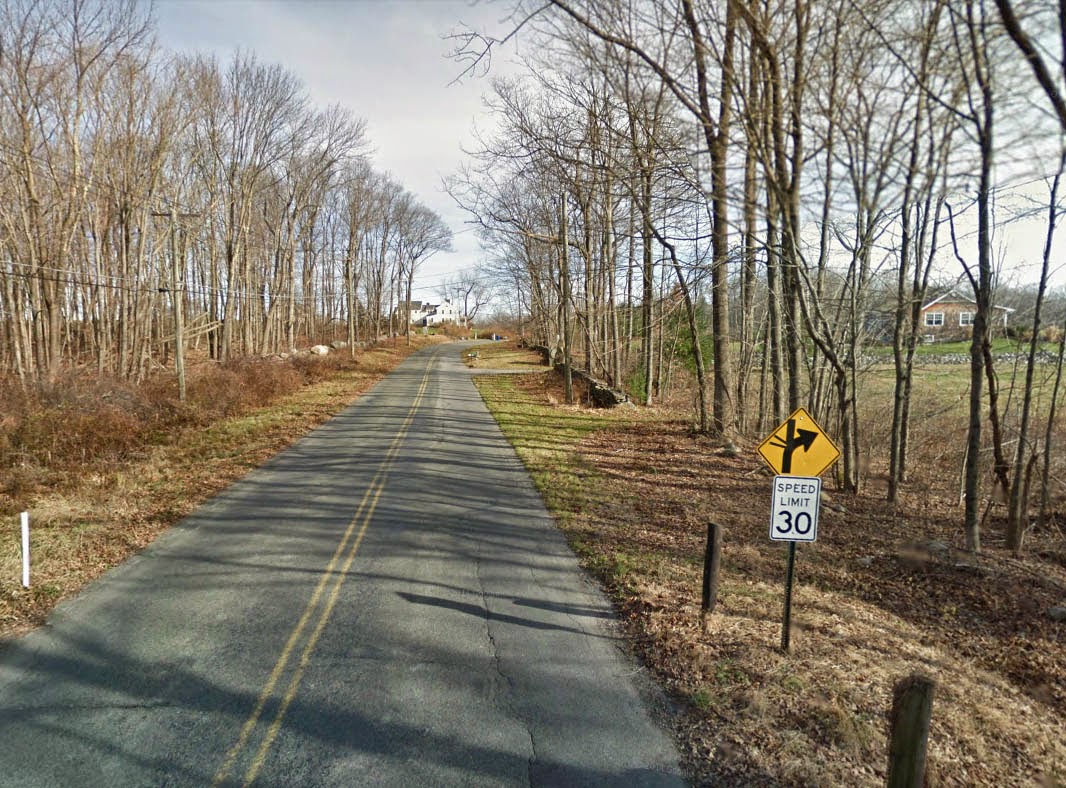
Maple St. approaching Brush Hill Road in Litchfield Township, CT is an example of local government too small to be able to manage traffic control devices.  With a population of 8,466 the town clearly does not have the resources to hire an engineering staff so traffic control maintenance is sparse and incorrect.  In this image you see an incorrectly applied combination curve/warning sign with a speed limit in lieu of an advisory.  The brook in the foreground lacks any object markers or guardrails (only driven in wood posts).  No sign at all is posted in the opposite direction for the hazardous curve condition, either.  Also note the faded out lines.  Behind this image is a three-way stop with 24" Stop signs (no longer standard), no "ALL-WAY" plaques and no "Stop Ahead" to warn of the condition northbound (image from Google Street View).


Another view of Maple St southbound approaching the above mentioned four-way stop.  This is a bit further north.  Note the "Slow Children At Play" haphazardly placed under Stop Ahead.  This road is a fairly straight road except for a couple sharp curves.  With a proper approach to centralizing traffic control responsibility away from the township, this road could have far better engineered traffic signs at minimal cost (image from Google Street View).

While the states may not be currently prepared to accept this responsibility, the focus of federal funding should also shift to make this possible.  While grant programs help, dedicating part of federal transportation dollars just to finance safety improvements is a wise step to assure that not only are states in compliance but also that local agencies are given the resources necessary to provide this service to their local community.  Likewise, the states should explore ways to consolidate many government functions in a manner to make such work as financially feasible as possible.  If states like Virginia, North Carolina, West Virginia, and Delaware, all states with limited revenues, can handle the responsible of traffic control devices on both state and county road systems through full state control, the other states who do not take this approach can certainly find a way to centralize this specific government function in which local agencies have proved unreliable, inconsistent and often inept at doing on their own.


What is this sign?  Is it a curve or is it a turn?  Also note the single line in the center in lieu of double lines.  This mess is found on Harrison Road northbound in New Hartford Township, CT.  Another one of many New England townships with shoddy traffic signs, these make up the functionally defunct Litchfield County.  As part of a county with 190,000 residents, revenues would likely be adequate to maintain all traffic signs correctly if traffic engineering and traffic signs were centralized to a county, regional or state level.  (Image from Google Street View)

Note that what is being said here is NOT that the state will have to do everything for the cities and counties.  There is room for local control, but local control must be engineer-driven including checks and balances to be effective.  Any county, city, town or township potentially could comply with the changes below simply by being properly trained by state authorities, having or using proper equipment, receiving conditional funding from the state or federal government just for that purpose, purchasing only from state-approved vendors, having all traffic engineering handled by qualified engineers and coordinating with state authorities on all traffic control procedures instead of operating independent of the state.  But "could" is the key word.  How much could they do if the budget in a township is $850,000 and hiring a PTOE alone would cost 12% of the budget?  Is it realistic to think that any local agency with a low population and small tax base has what it takes to do everything listed above?  They could do all of this, but not alone.  Likewise, the states could use more help with signage themselves.  

What many do not realize is that once devices are in place, the cost of maintenance is far lower than the initial major improvements if the responsible local jurisdiction is adequately maintaining them, can properly allocate resources for it, and the devices were correct to start with.  Major overhauls are only needed because those in charge failed or were unable to comply with proper standards, keep a proper sign inventory, properly invest in such work, or place traffic control devices without following proper protocols.  Knockdowns and stolen signs should be located and replaced, worn out signs should be replaced, damaged guardrails should be repaired, faded road striping should be replaced, signs should comply with sign plans and all traffic signs should be designed properly and those with proper knowledge should be able to point out significant errors with the ability to get them changed.  

By doing it correctly the first time and every time, costs would be reduced and safety would be greatly enhanced regardless of what road or what state one happens to drive on.  Obviously in the real world that means that some economies of scale are needed, and the best way to create those is to accept that consolidating some things such as highly technical matters to a more concentrated or higher level of government should be policy instead of optional.  Indeed, some things need to be handled from a level where following a proper process is not financially difficult or impossible.

Overbuilding leads to worse roads

Another problem that should be mentioned in regard to local control is overbuilding.  Unlike most centralized systems, local governments tend to overestimate the importance of roads they maintain by building roads that are too expensive to maintain.  This means lane width in excess of what is needed, road projects that are not needed, and speed designs that require larger, sturdier safety improvements than they can afford.  This also means simple things like placing center and edge lines on low-volume, functionally local roads that take resources from other needs for what amounts to expensive paint.  This actually promotes more hazardous conditions, because it makes these roads look and feel like highways when the roads are not maintained or retrofitted at the same level as a highway.  The cost of maintenance also takes funds away from road projects on more important roads leading to greater hazards on those roads as well.  This falls under the "squeaky wheel politics" problem of local control where "showy" things like nicer, faster roads take priority over "less showy" routine maintenance work and lower cost solutions.  Very often, the "showy" road that is upgraded does not need it while the ones that do are ignored.  

Inversely, local control also leads to primitive roads in poorer, rural areas.  States that do not invest in local road network improvements lead to rural areas having few paved roads compared to those who do.  This creates hazards from the road surface itself while also creating gaps in collector routes that force more traffic onto other roads that do not need additional traffic since through traffic typically avoids or is required to avoid (such as trucks) severely substandard roads.  

SUGGESTED MUTCD REFORMS IN REGARDS TO RESPONSIBILITY FOR TRAFFIC CONTROL DEVICES

NOTE: To traffic engineers who read this next part, this is NOT to be viewed or adopted as an actual change in public policy unless adopted and approved by FHWA and the NCUTCD.  If these changes were adopted, they would become part of the actual MUTCD.  This is a suggested revision based on field observations in many states, and this is an entirely independent analysis.

The suggested changes to Section 1A.07 should be as follows.

Section 1A.07 Responsibility for Traffic Control Devices
Standard:
01 The responsibility for the design, placement, operation, maintenance, and uniformity of traffic control
devices shall rest with the public agency or the official having jurisdiction the state agency, multi-jurisdictional regional agency of adequate population threshold or federal agency authorized to regulate public roads in their respective state, federal land or federal district, or, in the case of private roads
open to public travel, with the private owner or private official having jurisdiction. 23 CFR 655.603
adopts the MUTCD as the national standard for all traffic control devices installed on any street, highway,
bikeway, or private road open to public travel (see definition in Section 1A.13). When a State State or other
Federal agency manual or supplements are is required to clearly define state or federal specific signs, sign standards and regulations that are otherwise not otherwise present in the National MUTCD.  , tThat manual or supplement shall be in substantial conformance with the National MUTCD.
Guidance:
08 States should adopt Section 15-116 of the “Uniform Vehicle Code,” which states that, “No person shall
install or maintain in any area of private property used by the public any sign, signal, marking, or other device
intended to regulate, warn, or guide traffic unless it conforms with the State manual and specifications adopted
under Section 15-104.”
09 States should not permit individual local authorities to have exclusive jurisdiction or responsibility for the layout, installation and maintenance of traffic control devices.
10 Supervision of all traffic control devices should be under a qualified traffic engineer, preferably with a PTOE certification.
11 Any government agency unable to afford to hire one or more traffic engineers whose specific responsibility is to oversee traffic control should partner with the state or other local agencies to the extent that they are capable of affording it.
12 States, statewide agencies working on behalf of local governments, private engineering firms working on behalf of the state or statewide agency, regional traffic control cooperatives or federal agencies should design, engineer, install and maintain traffic control devices in all local jurisdictions that are financially or structurally incapable of fully maintaining traffic control devices to MUTCD standards.
13 Any state, district, territory or subdivision of a state, district or territory may partner with an adjacent state, district or territory or subdivision of a state, district or territory for the purpose of maintaining traffic control devices.
14 Preferably, states should structure their road system so that any technical operation, including traffic control devices, are planned, designed, installed, and maintained by a public agency that functions at a level comparable to the state DOT and completes this work on behalf of multiple counties, cities, and towns within a defined region or the state as a whole

The suggested changes to Section 1A.08 should be as follows.

Section 1A.08 Authority for Placement of Traffic Control Devices
Standard:
01 Traffic control devices, advertisements, announcements, and other signs or messages within the highway
right-of-way shall be placed only as authorized by a public authority or the official having jurisdiction the state agency, multi-jurisdictional regional agency of adequate financial and/or population threshold or federal agency authorized to regulate public roads in their respective state, federal land or federal district, or,
in the case of private roads open to public travel, by the private owner or private official having jurisdiction,
for the purpose of regulating, warning, or guiding traffic.
02 When the public agency or the official having jurisdiction over a street or highway or, in the case of
private roads open to public travel, the private owner or private official having jurisdiction, has granted
proper authority, others such as contractors and public utility companies shall be permitted to install
temporary traffic control devices in temporary traffic control zones. Such traffic control devices shall
conform with the Standards of this Manual.
03 All regulatory traffic control devices shall be supported by laws, ordinances, or regulations in compliance with state and/or federal law.
Support:
04 Provisions of this Manual are based upon the concept that effective traffic control depends upon both
appropriate application of the devices and reasonable enforcement of the regulations, thus state and/or federal agencies must have final jurisdiction over devices and regulations regardless of whether roadway is under state, regional or local ownership with states instead of local agencies responsible for regulating such devices regardless of the actual agency responsible.
05 Although some highway design features, such as curbs, median barriers, guardrails, speed humps or tables,
and textured pavement, have a significant impact on traffic operations and safety, they are not considered to be
traffic control devices and provisions regarding their design and use are generally not included in this Manual.  Responsibility, however, must be treated the same as traffic control devices with jurisdiction falling under the same state and federal agencies to assure uniformity in application and maintenance.
Standard:
07 Signs and other devices that do not have any traffic control purpose that are placed within the highway
right-of-way shall not be located where they will interfere with, or detract from, traffic control devices.
Guidance:
08 Any unauthorized traffic control device or other sign or message placed on the highway right-of-way by a
private organization or individual constitutes a public nuisance and should be removed. All unofficial or nonessential

traffic control devices, signs, or messages should be removed.  
09 The state has the authority to determine if such devices are non-compliant and may require correction or removal along roadways maintained by local or regional authorities unless those regional authorities possess the same technical knowledge, hold the same professional standards as the state agency, and are able to demonstrate that they can meet or exceed all state or federal requirements.
10 The appropriate federal agency where no conflict of interest is present has the authority to determine if such devices are non-compliant and may require correction or removal along roadways maintained by various federal agencies or the District of Columbia.

The suggested changes to Section 2A.03 are as follows:

Section 2A.03 Standardization of Application
Support:
01 It is recognized that urban traffic conditions differ from those in rural environments, and in many instances
signs are applied and located differently. Where pertinent and practical, this Manual sets forth separate
recommendations for urban and rural conditions.
Guidance:
02 Signs should be used only where justified by engineering judgment or studies, as provided in Section 1A.09. 03 Engineering judgment or studies should only be performed under supervision of the responsible state, regional or federal agencies.  Local agencies may not perform engineering studies without subsequent review and approval of all plans by the state, regional or federal agency with ultimate oversight over a particular jurisdiction.  Engineering judgment by local authorities is subject to review by state or federal agencies.
04 All federal-aid eligible roadways, regardless of jurisdiction, are required to have engineering studies reviewed by the state or federal agency responsible and must comply with MUTCD standards in order to receive federal funding.

Wednesday, December 3, 2014

Shoddy Signs Spotlight: Coffee County, TN

Tennessee counties are among the worst when it comes to proper installation and maintenance of traffic control devices.  With adequate state level revenues, the fact remains that very few counties in the state do it correctly.  Prior to the High Risk Rural Roads grant program, the state for decades has also made no direct investment in helping counties in this area.  In fact, the majority of rural roads in Tennessee have few to no traffic signs posted at all regardless of whether they are a designated collector route or a functionally local road.  One of those reasons is that very few counties have a county engineer (less than 10 out of 100 counties) due to resources being spread thin over many rural counties.  It's not that these counties make no effort at all, but the interest in having consistent standards or full compliance with the MUTCD is a low priority and, prior to HRRRP, absolutely no portion of state funding was applied to correcting or updating safety issues on Tennessee's county roads.

Perhaps it should also be noted that cities are favored over counties for state-aid by a wide margin meaning counties are pretty much left on their own.  It is telling in the way that consolidated city-counties and larger cities tend to do a much better job with traffic control even in high population areas.  In fact, Tennessee has been second only to Georgia in their push to consolidate city and county governments indicating that there is definitely a funding problem for counties.

Tennessee also has some of the most mountainous terrain in the United States, so this makes rural county roads particularly dangerous.  TDOT also functionally classifies all local roads outside of urbanized areas with no classification higher than "minor collector", which makes the former federal-aid secondary roads apparently ineligible for federal-aid.  By extension this makes it more difficult to invest in improvements on the most heavily traveled county roads.  With sharp curves, steep drop-offs and often narrow roadways without any shoulders these are the roads that should have the most safety upgrades.  In geometry, they are quite similar to Virginia's secondary state roads except for the dearth of adequate safety improvements.

In Tennessee, the culture of local control with little state interference is also strong.   In fact, Tennessee is unique in that road commissioner is an elected position separate from the county mayor.  Because of this separate elected position, there is even less accountability in regards to road standards than other states where roads fall directly under the county administration.  Most rural counties in Tennessee are also quite poor, so when the money for road improvements starts flowing, safety improvements take a very low priority.  It is not uncommon to see traffic signs from federal-aid projects left over from the 1960's that never get replaced, although TDOT's rural safety program has at the very least replaced many of these decrepit signs.  What does in fact get replaced is also quite substandard.  Likely those federal-aid projects are also the only instance that any actual traffic study was ever completed for signs.  Roads also only tend to be restriped after being repaved making roads that have not been resurfaced in a number of years very dark at night.  Guardrails installed in the 1960's with blunt end guardrails also are still commonly found along county-maintained roads.

Since Tennessee is among the worst states for MUTCD compliance on local roadways, a large number of counties will eventually be featured on the "shoddy signs spotlight" feature of this site.  While this is likely to offend these counties and cities who do this, they may not even be aware that there is a problem.  It is hoped that seeing this will inspire them to consider strategies like those proposed on this blog to fix these issues.  Counties will not be the only thing shown, though as municipalities in most states actually have far more issues than the counties.

COFFEE COUNTY, TN

Coffee County, with a population of over 50,000, is actually not one of the worst cases for poorly maintained traffic safety improvements in the state.  The county was picked initially partly because they actually have made an effort beyond what other counties in the state have done.  Because of this, it is far easier to showcase the numerous issues with visible roadway features than to show a county that has little in the way of signage at all.  This post is actually to show what they're doing wrong and how it could be done better.  Most likely at least the signs themselves that will be shown here will eventually be corrected through the federal-aid safety projects, but it is important to note that what might look okay to the naked eye actually is not and also needs policy changes.  Several locations will be highlighted with images showing the problems in this post.  


Westbound Rutledge Falls Road.  The Rutledge Falls parking area is to the right.  The curve ahead is actually the sharpest turn in the beginning of a series of curves with two sharper curves.  It is posted with a turn sign eastbound as is shown in the next image. (Google Street View)


Eastbound Rutledge Falls Road approaching the same sharp turn as above, but posted instead with a turn sign.  Using a curve or turn sign in a sharp turn is not optional depending on the direction or what type of sign is available in the shop.  It's either a turn or a curve.  (Google Street View)


A short ways to the west of the sign above is this winding road assembly marking the two sharper and two smaller curves in the vicinity of Rutledge Falls.  The terrain forms a small hollow along a low plateau where the curves are located. (Google Street View)

Rutledge Falls Road shown here is designated by TDOT as a minor collector.  It has some pretty typical errors for rural counties in Tennessee.  This series of turns on Rutledge Falls Road was shown to highlight the typical lazy work being done by local governments in many states.  It appears at some point the county road commissioner decided to install curve warning signs county-wide, but they never hired a traffic engineer nor did they correctly follow the MUTCD in the process.  A number of issues are noted in these images:
  1. The advisory speed posted does not appear to have actually been determined properly (ball-bank study).  The way that it is posted for the W1-2L curve southbound but the W1-5L winding road northbound is misleading.  Likely the advisory speed would be higher.
  2. The curve in the first two photos is posted as a curve southbound, but it is posted as a turn northbound.  You can't have two different types of curve warning signs in different directions marking the same condition.  If the 15 MPH advisory speed is correct, then only W1-1 turn signs should be posted.
  3. Warning signs posted are 24" signs.  While this was still compliant when these signs were posted, this is no longer a compliant practice to use 24" signs for curve warning situations.
  4. "SLOW" signs are posted.  Slow (formerly W42-2) is a removed MUTCD sign and are basically useless as a warning sign giving a vague message to drivers.  It was removed from the MUTCD in 1961.  At least in this instance it was included with a 15 MPH advisory speed although better ways to enhance the sign could be used such as orange diamonds, flashing beacons and larger signs.
  5. The signs look cluttered.  While overlapping of warning and advisory signs is not expressly forbidden, it has a knack for making signs look less important and thus less noticeable and more difficult to read.  Most likely this was done, because the county did not specify anything higher than an 8' direct-driven post.  It is known that many rural counties lack sign trucks and thus are unable to post taller signs.
  6. The post height is way too low.  On the clustered curve/slow/advisory combos, the bottom of the signs almost touches the ground.  Rural applications are supposed to have a minimum of 5' above the edge of pavement per the MUTCD.  In no way is this the case here where signposts appear to be near uniformly no more than 5-6' above the ground county-wide.  The reasons are specified in #5 above.
  7. The southbound curve sign in the first image is not MUTCD-spec.  This non-standard W1-2 design was applied county-wide with at least half of the curve signs posted with that look.  This was likely either an in-house job or a purchase from a sign vendor that was not state-approved (or not properly reviewed for compliance).  Many of the cheaper sign vendors produce traffic signs with designs that are not in compliance with the MUTCD.
  8. As typically noted statewide, the lines on the roadways are faded out and need to be re-striped.
  9. The double arrow sign posted at the junction of Cat Creek Road and Rutledge Falls Road is bolted to a tree and warped by tree growth.  It also has incorrect design and dimensions.
  10. Stop signs (not shown) are 24" x 24" and are no longer compliant needing replacement with standard 30" x 30" signs.

The image above annotated from Google Earth highlights all the issues with potential corrections to each traffic engineering issue.  Also included was a D1-1 guide sign to indicate the change of direction along the minor collector routing.

The situation presented on Rutledge Falls Road is by no means an isolated condition.  County-wide, severe traffic hazards are present because of shoddy sign work.  The next series of photos captured from Google Maps will highlight some of the many other areas where major improvements are needed.  The hope is that elected officials will find the means to begin to correct these issues, form a cooperative with other cities/counties to improve standards/oversight and/or push the state for a direct role in maintaining roadway safety features.  The county should also pursue a combination of resources with cities to help improve economies of scale and normalize roadway standards.  


Powers Bridge Road west of Manchester features a very dangerous situation with the guardrail on the left side lacking any anchor whatsoever located very close to the edge of the roadway.  The background sign is also incorrect using a T-intersection sign (W2-4) instead of the appropriate W2-2.  Also note the faded out condition of the lines on the roadway.  If full road striping is too costly then at least the centerline should be well-maintained.  (Google Maps)


Old Woodbury Highway north of Gowan Road has W1-8 chevrons posted on the wrong side of the road and posted incorrectly.  This is a 90 degree turn.  Behind this only a W1-1 turn sign is used (no advisory). (Google Maps)


These non-standard curve signs were found county-wide a decade ago, and are still found in most areas of the county.   This sign was noted on Wayside Road east of Pete Sain Rd. They do not have a correct design and were loosely applied to nearly every condition that involved a curve.  As noted in the background, chevrons are posted.  Chevrons are usually posted if the curve has an advisory speed 10 or more miles less than the roadway. (Google Maps)


Major engineering, safety and sign design issues are found on Short Springs Road (part of the same minor collector route as Rutledge Falls Road) in the City of Tullahoma (inside Coffee County).  The first shows a completely non-standard device used to mark the curve approaching the Bobo Creek bridge.  This is followed by a short blunt-end guardrail segment approaching a bridge with no railing.  However, the object markers on the bridge were applied correctly. (Google Maps)

It was noted through Google Earth that a highway safety project was underway in 2013 in Coffee County along Fredonia Road as well as work noted on Maple Springs Road.  While it is possible that further issues are planned for correction through the Local Roads Safety Initiative (TDOT's application of the HRRP similar to GDOT's Off-System Safety Improvement Program), it is important to note that these issues should have never been present and that the HRRP is a goal-oriented program financed largely with federal funds.  This does not fix a systemic problem.  The improvements do not mean that any local policies were changed.  While the county should continue to seek help at improving these issues, the county should begin to improve many practices on their own.  As a middle population county, the resources are available to do a better job than they've been doing if used efficiently.  The steps the county alone should take are:
  1. ENGINEERING STUDY: Hire a PTOE or traffic engineering firm with a PTOE to review all of the county's signs and guardrails with priority given to roadways designated collector or arterial.  This should include a traffic study that corrects every engineering issue and details modifications whether or not funding is available to fix them.
  2. POST HEIGHT: Correct post height issues throughout the county.  Signs need to be much higher than they are posted now so that they at least comply with the 5' minimum clearance.  The cheapest short-term way to do this is to take the existing posts, pull them out of the ground and install a 3' soil anchor cleaning off the base of the taller post.  This will automatically add 3' in post height.
  3. TDOT STANDARDS: Adopt TDOT standards including purchasing signs only from state-approved vendors to correct sign issues.
  4. TECHNICAL ASSISTANCE TRAINING: Send employees involved with installation, layout and maintenance of traffic control devices to seminars to learn how to do it correctly.
  5. INSPECTION: Have an engineering consultant annually spot inspect traffic control devices for errors.
  6. MUTCD STANDARDS: Follow MUTCD standards when installing and replacing any sign.  This means at the very least make sure signs comply with designs in the Standard Highway Signs manual and that sign dimensions comply with the charts in the MUTCD.
  7. FUNDING/REPLACEMENT SCHEDULE: Continue to use state/federal help whenever possible and budget an annual zone installation/replacement schedule on roads that received traffic engineering studies.
  8. DATA INVENTORY: Inventory all new signs installed with GIS mapping and GPS coordinates.
  9. GUARDRAIL SAFETY: Replace dangerous guardrails and guardrail anchors county-wide.
  10. BRIDGE RAILS: Improve bridge rails with either guardrail treatments, repairs or new railing.  Using surplus railing is acceptable as long as it has proper breakway anchors, is installed correctly and is not too low.  If the railing is concrete, contract with the state for those repairs.
  11. COOPERATIVE MAINTENANCE: Develop a regional traffic control cooperative based on the planning region with adjacent counties and cities for layout, installation, fabrication and maintenance of traffic signs, guardrails and pavement markings.  If TDOT offers, hire them as a contractor to maintain these items on behalf of the county.
  12. SERVICE SWAPPING WITH TDOT: Broker a service swap agreement with TDOT that amounts to the county providing specific road maintenance services on behalf of the state in turn for an equivalent amount of traffic control maintenance on county roads.
TDOT should also note this as an example of how even middle-population counties struggle to provide proper maintenance of traffic safety devices.  This and many other examples should lead to a plan to provide annual funding from the state DOT budget to counties and cities with the state either furnishing safety items for local governments or reimbursing local work if that work complies with TDOT standards and engineering studies.  At no point should these safety improvements been allowed to become this substandard.  If Coffee County formed a cooperative, then state-aid should be applied to the cooperative to allow a more efficient and effective plan for upgrading and replacing defective devices.

It is hoped that examples such as Coffee County will lead to changes that assure that even with limited funds that what is in place on the roads is done the correct way.  If a local agency cannot install and maintain traffic signs to proper specifications, then they should not be posting them at all.  It is better that any local agency does not post any signs than for them to post them incorrectly.  The latter is actually far more hazardous and is not very effective.  It is hoped that by highlighting all of these issues that action will be taken to systematically correct these problems in the best manner possible while funding on a state level is available to make the process far more feasible.