Starting in 2004, Georgia began to lead the way to address substandard maintenance of traffic control devices. Tennessee followed suit with a nearly identical program in 2009. Georgia's began with a pilot program, and this program was created to address this most neglected aspect of local road maintenance. It provided specific funding for:
- Traffic signs (regulatory and warning)
- Traffic control studies
- Pavement markings (striping, raised pavement markers, other pavement markings)
- Guardrail repair and replacement
- Mowing and brush cutting to provide better visibility
Prior to this program, most local governments did not take this type of work seriously. While stop signs and street name signs were obviously more frequently maintained, most local governments were neglecting this work. In addition, other traffic control took more of a backseat when rural counties became responsible for posting D3-1 street name signs: a major local expense. Old, worn out signs were common. Many signs were 20 up to even 40 years old. Local governments were likewise doing this work without any direction from a qualified traffic engineer. The result were dangerous errors and omissions on road after road. It was the equivalent of driving at your own risk.


What a difference proper safety improvements make! This steep drop-off into Wolf Creek on Owltown Road in Union County previously had no signs warning of the hazardous condition along with inadequate pavement markings. Federal-aid funding fixed this dangerous condition, but will county forces be able to keep it up? These have been needed since the road was first paved in the 1980's.
Georgia's interest in this program coincided with a change in policy in the FHWA in regards to local safety improvements. It was discovered that the highest accident rates and deadly crashes were not on the busy urban streets but on rural roads. Duh.
When you have thousands of local governments thinking traffic control is a luxury item, it is going to cause people to get killed. Thus, the federal government began funding safety projects if the states organized an acceptable means to distribute the funds. As Georgia's plan evolved, the state has taken an increased role in making sure the projects have been done correctly. The initial program mostly involved striping projects and replacing traffic signs in place with no engineering studies. Today, the state's work includes full-scale renovations of specific roads awarded to counties, cities and towns on a first-come first serve basis, but proper traffic studies are by no means a uniform approach with only some districts and some local agencies taking this badly needed extra step.
In all, this plan has led to significant improvement, but the results are still very patchy. It can easily be said that the majority of roads have still not been covered. Many, many local agencies just replaced their existing signs without making any modifications, and GDOT's District 6 in particular has avoided financing traffic studies to correct engineering errors present along those roads. Thus, in many cases an unsafe condition was replaced with another unsafe condition posted at the proper height that is easier to see at night. Obviously other areas do not need as frequent of maintenance and have improved: especially road striping and guardrails. If anything, both of those were vastly improved over the typically non-existent lines and neglected guardrails found on county roads prior to 2004. Nevertheless, even guardrails sometimes need frequent repair. A crash-prone guardrail cannot just be replaced once every 20 years. It may need to be replaced more frequently: something that just does not happen in either a rural county or small city/town/township.
In all, maintenance is not a project to be rewarded infrequently. It takes a constant effort to make sure that everything is where it needs to be, is done right and is continuously up to code. Will these states shift their efforts when these federal-aid projects have fixed the majority of issues? We can only hope so, but for now the plan as it exists could stand to have significant tweaking.
When you have thousands of local governments thinking traffic control is a luxury item, it is going to cause people to get killed. Thus, the federal government began funding safety projects if the states organized an acceptable means to distribute the funds. As Georgia's plan evolved, the state has taken an increased role in making sure the projects have been done correctly. The initial program mostly involved striping projects and replacing traffic signs in place with no engineering studies. Today, the state's work includes full-scale renovations of specific roads awarded to counties, cities and towns on a first-come first serve basis, but proper traffic studies are by no means a uniform approach with only some districts and some local agencies taking this badly needed extra step.
In all, this plan has led to significant improvement, but the results are still very patchy. It can easily be said that the majority of roads have still not been covered. Many, many local agencies just replaced their existing signs without making any modifications, and GDOT's District 6 in particular has avoided financing traffic studies to correct engineering errors present along those roads. Thus, in many cases an unsafe condition was replaced with another unsafe condition posted at the proper height that is easier to see at night. Obviously other areas do not need as frequent of maintenance and have improved: especially road striping and guardrails. If anything, both of those were vastly improved over the typically non-existent lines and neglected guardrails found on county roads prior to 2004. Nevertheless, even guardrails sometimes need frequent repair. A crash-prone guardrail cannot just be replaced once every 20 years. It may need to be replaced more frequently: something that just does not happen in either a rural county or small city/town/township.
In all, maintenance is not a project to be rewarded infrequently. It takes a constant effort to make sure that everything is where it needs to be, is done right and is continuously up to code. Will these states shift their efforts when these federal-aid projects have fixed the majority of issues? We can only hope so, but for now the plan as it exists could stand to have significant tweaking.
THE ISSUES WITH BOTH STATE'S METHODS
The federal-aid safety projects through the High Risk Rural Roads Program (HRRP) have made a huge improvement in the engineering and quality of county roads across both Tennessee and Georgia. However, in many ways it is a big bandage covering a bigger problem in the two states who do in terms of traffic control devices.
- The issues requiring a complete overhaul should not have been present in the first place, especially on federal-aid eligible roadways.
- While the projects address most of the present safety issues, they do not address the larger issue in that these local agencies are still not equipped financially or structurally to maintain technical traffic operations work.
- Many errors exist on these sign projects that are never corrected on a local level
- Projects are spotty and happen every 5-10 years. They do not overhaul entire road networks in individual jurisdictions. Instead, they only address specific roads.
- Neither state provides any maintenance nor traffic engineering services once these projects are complete
- Guide signs are completely omitted from projects except for in-place replacement with no design modifications if the original signs were incorrect. Proper guide signs should be considered part of safety and should be funded by the state even if federal funds do not cover it.
- Traffic studies are not always performed on these projects resulting in signs that, while MUTCD compliant in design, height and reflectivity are not properly engineered thus creating a greater hazard since they "appear" correct.
- Local governments are under no obligation to either maintain to the same standards nor eventually replace these signs under another agreement. They will do little to nothing if another state administered federal grant is not provided.
- Funding is not committed from a state level. While there is (now) a state funding match (in Georgia), it is largely a federally-funded program. The program will end if the federal program ends.
- Federal funding in this program competes for other safety funding including on the state highway system meaning the funding could be stripped away from local governments to use exclusively on state-owned roads or used for purposes other than traffic control.
- Local governments have broad powers to choose these projects and can decide against them if they do not want to maintain costlier compliant signage meaning that some local governments with the worst conditions deliberately opt out of the program.
- Safety projects are often oversigned and are not planned with any consideration of the financial or structural capabilities of the local governments in maintaining them.
Below each point will be detailed in a single paragraph:
The issues requiring a complete overhaul should not have been present in the first place, especially on federal-aid eligible roadways
The issues requiring a complete overhaul should not have been present in the first place, especially on federal-aid eligible roadways
First, it should be noted that a complete sign overhaul proves that both the state and local agency was aware of a problem but was unwilling to do anything about it before work was commenced on a federal-aid safety upgrade. If the road was being properly maintained in the first place, there would be no need for a full-scale re-engineering nor replacement of every sign. Clearly in these situations both the local government and the state have failed in their duties. The local agency has failed to set aside funding and properly supervise their own road system while the state has failed to develop a strategy where local work is properly inspected, planned and/or funded. The result is that an unsafe condition has persisted for decades that has, in fact, only been addressed adequately for the first time. Regardless of the improvement, the division of funding and responsibilities has failed the public and should be viewed as a serious concern. If the traffic control devices were maintained correctly as it is, this work would consist of nothing more than small spot corrections and replacement of worn out signs. A complete re-engineering demonstrates one of two things. The first is that traffic engineering work was inappropriate, obsolete or incorrect in the first place. The second is that no engineering studies have ever been conducted at all along a stretch of road.


While the projects address the issues, they do not address the larger issue in that these local agencies are still not equipped financially or structurally to maintain this technical traffic operations work

Stinking Creek Road (NFA 1280) westbound at D.W. Baird Lane in Campbell County, TN. This road was paved and realigned as a federal-aid project in 1960. Note that the sign in the image is delaminated, which typically happens to traffic signs that have remained in place too long. Even if this sign is replaced tomorrow, this shows that Campbell County has neglected traffic control for 55 years. Image from Google Street View.

Farner Road southbound in Polk County, TN. This sign was likely installed when the road was first paved and is covered in lichens (as well as faded to pale yellow). While some other signs on the road were eventually replaced, many others are missing or incorrect. This shows the half-hearted effort by the local agency. Replacements also contain many errors like what was described in the discussion on curve warning signs.
While the projects address the issues, they do not address the larger issue in that these local agencies are still not equipped financially or structurally to maintain this technical traffic operations work
This situation of course highlights the point that the majority of local agencies are not able to handle traffic control to the levels necessary. Budgets in low-income or rural counties simply are not adequate to address an effective traffic control strategy without taking significant funding from essential services and projects. The economies of scale are also too low to provide the cost-efficiency necessary to overcome this. Likewise, the local governments typically lack the equipment, standards, trained professionals or facilities to run a proper traffic sign maintenance operation. Only wealthier and higher population cities, counties and states have the ability to handle this level of work to acceptable levels. Even then, the ignorance on a local level in regards to traffic control operations mean that urbanized counties and cities in many cases may be just as bad if not worse than they tend to be in a lower population area.


Dahlonega, GA shows that while they seem to understand about post height that they are otherwise confused. Are they advocating that you drive 25 MPH past a stopped bus?

This blind curve in Polk County, TN is not indicated with anything more than this completely non-compliant assembly. The speed limit sign should be replaced with a W13-1 advisory and "SLOW" replaced with a right curve sign (W1-2R). A curve with limited sight distance was noted on the hill past this sign.
While these federally-funded projects make it easier for these rural governments to maintain what they have, the fact is that a huge sudden uptick of traffic control devices to maintain is not realistic for a rural local agency. When these signs wear out they will likely go without replacement for many years past their service life, missing and vandalized signs won't get replaced, obsolete signs will not get updated, and replacement signs may be incorrect/substandard. This is evidenced by previous work completed in the 1960's and 1970's on locally-owned roads: much of it still in various states of decay today where the federal-aid safety grants have not been implemented.
Many errors exist on these sign projects that are never corrected on a local level

Even if this sign was properly studied, the application and compliance is unacceptable. This photo was taken October 19, 2014 in Gilmer County, GA on Whitepath Road.

This sign in the Cherry Log community of Gilmer County, GA was installed in 1989 as part of a state highway project and is clearly far past its service life.

Dahlonega, GA shows that while they seem to understand about post height that they are otherwise confused. Are they advocating that you drive 25 MPH past a stopped bus?

This blind curve in Polk County, TN is not indicated with anything more than this completely non-compliant assembly. The speed limit sign should be replaced with a W13-1 advisory and "SLOW" replaced with a right curve sign (W1-2R). A curve with limited sight distance was noted on the hill past this sign.
Another issue involves the sign projects themselves. As in all roadway projects, a few errors are made that require correction after the contract has closed. Humans are not perfect, and they make mistakes: especially if the mistakes are made in a situation that is less critical. The problem with these sign projects is that errors are made that are not corrected. When the project closes and the sign work is transferred back to the local government, there is no trained technician or engineer to point out the issues and quickly correct them. Instead, the problem remains untouched for the next decade or more. This was noted many times.
In a state-aid safety project project in Towns County, GA, it was observed that in one location a reverse turn (W1-3) sign was pointing in the wrong direction and a turn sign (W1-1) was used in two locations where a winding road sign was supposed to be. These issues were not fixed, and this project was completed seven years ago. The state was unable to fix them since they had no authority over the road. On the other hand, the county lacked the funding, resources or interest in correcting the problem thus it never was fixed. In the more recent Union County, GA project several errors were noted including an intersection sign for a private driveway on one road and a missing turn sign on another road (posted in the opposite direction). These also are not likely to be fixed since the engineer's work on the project ceased when the contract ended and neither county has any staff engineers to inspect traffic control. The state at this point has no authority to go back and make small changes to fix these issues. Similar errors were noted in Tennessee along Sciota Road in Unicoi County, TN where the field work did not correctly match traffic studies with curve signs incorrectly applied in several locations.
Projects are spotty and happen every 5-10 years. They do not overhaul entire road networks in individual jurisdictions. Instead, they only address specific roads
In a state-aid safety project project in Towns County, GA, it was observed that in one location a reverse turn (W1-3) sign was pointing in the wrong direction and a turn sign (W1-1) was used in two locations where a winding road sign was supposed to be. These issues were not fixed, and this project was completed seven years ago. The state was unable to fix them since they had no authority over the road. On the other hand, the county lacked the funding, resources or interest in correcting the problem thus it never was fixed. In the more recent Union County, GA project several errors were noted including an intersection sign for a private driveway on one road and a missing turn sign on another road (posted in the opposite direction). These also are not likely to be fixed since the engineer's work on the project ceased when the contract ended and neither county has any staff engineers to inspect traffic control. The state at this point has no authority to go back and make small changes to fix these issues. Similar errors were noted in Tennessee along Sciota Road in Unicoi County, TN where the field work did not correctly match traffic studies with curve signs incorrectly applied in several locations.
Projects are spotty and happen every 5-10 years. They do not overhaul entire road networks in individual jurisdictions. Instead, they only address specific roads
This brings to the point the nature of such projects. The federal government provides a small pool of money for this work. Since it must be distributed a certain way annually in each district, this means that the state basically awards an amount to various local jurisdictions in lieu of a blanket federally-funded maintenance program. Once every 5-10 years, a county, city or town usually receives road striping and replacement of signs on a few roads with the rest left untouched until the next project comes around. If there are any remaining issues, then they must wait another decade or more to get fixed. The overall result is that the local agency is left with a partially finished job where they then must theoretically come up with the rest for any other sign work, which they usually do not do. Thus, you have a one-time job that is then returned to local control with errors that do not get fixed. After the job is completed, nothing else significant is done until another contract that may or may not come in another decade depending on either the available state/federal funding and interest on a local level. Moreover, the next job if it happens will likely not have another study meaning that the same problems will just be replaced in-kind with new problems. Since the entire road system is usually not done, a future project will often not be applied along the same roads thus delaying work on the original roads for as much as 15-20 years. That is not a sound maintenance strategy.


Monroe County, TN had a spot safety improvement project on many roads across the county. However, that did not include this stretch of Old TN 68 just north of Tellico Plains. In the first image, the reverse curve condition does not even exist any longer since the intersection was reconfigured into a stop condition.

Sign rot has overtaken this sign installed on Grandview Road in Pickens County, GA (a minor collector). The signs on this road were installed in 1980 as part of a paving and realignment of the road. Most have never been replaced. Pickens County has also had at least two off-system safety improvement projects. Most of those projects were not even done along major county roads such as this one.
Neither state provides any maintenance or traffic engineering services once these projects are complete
As was mentioned earlier, the state does not provide any traffic control maintenance to local governments after contracts are completed forcing cities and towns to again resume the responsibility they failed to do correctly the first time. Cities and towns should not be depended on to provide this type of work in the first place, so clearly they should not be stuck with this job unless they find a way to pool their own resources into a statewide cooperative that can do this at or near state levels. While the state should be able to take advantage of federal money, there should also be a guaranteed annual allotment distributed through state forces to provide traffic operations services on behalf of local governments. At the very least, state funds should create a traffic control cooperative agency that allows local agencies to pool their available funds for traffic control while the state covers the operations costs on behalf of the local agencies. In addition, local agencies should be required by law to follow the same engineering and maintenance standards of the state: something that will require the local agencies to either consolidate this function or jointly fund with other local agencies a private engineer firm to manage traffic control for local governments. This does not mean the local government can never put up signs, but what the state does not fund should follow engineering plans, directives, and comply with state and federal standards. Anything else should not be allowed on any public road in the state. This means that even locally-funded work will be required to comply with nominal state and federal standards as a condition of state funding to the local governments.
Guide signs are completely omitted from projects except for in-kind replacement with no design modifications if the original signs were incorrect
Guide signs are completely omitted from projects except for in-kind replacement with no design modifications if the original signs were incorrect
In these off-system grants, guide signs have been treated like a stepchild. State DOT's and counties alike have begun treating guide signs as something "nice to have, but not necessary", but poor information to the road user can be just as hazardous as inadequate warning signs. Road networks are confusing and GPS systems do not always guide motorists on suitable roads. Guide sign funding can help finance better street name signs, fund signage for county farm-to-market routes, pay for advance intersection signs and manage traffic flow in a way that reduces congestion on major highways. Guide signs being described here usually include the green destination and distance signs typically found along state highways, route markers (interstate, US, state, county and town), recreational guide signs, larger expressway guide signs and informational signs such as facilities, airports, stream crossings and jurisdictional boundaries.

While guide signs are typically not viewed is as critical as warning and regulatory signs, a confused motorist taking the wrong road can lead to accidents or worse. Local governments in far too many states as well as many state DOT's have proven that they do not see the installation and maintenance of guide signs as important. From the unsigned, but designated alphanumeric county highways in California to the decayed former state route signs in Florida to the shoddy workmanship of route and guide signs maintained by many cities/towns along state-owned roads in Virginia, guide signs are a low priority compared to other signs. It is not uncommon to see still-useful guide signs decades old along former highway alignments that ultimately disappear instead of being replaced. Unfortunately, the current policy is essentially that unless a guide sign is already in place the federal funding will not cover their replacement.

This left over guide sign on Old TN 68 first installed by the county before Mecca Pike was a state highway was never MUTCD compliant in the first place, but its lack of maintenance is fairly typical for guide signs on rural local roads. When the roadway was moved, the state should have still been installing and maintaining guide signs along the local roadway. If this was upgraded today, it would most likely be replaced with simply a trailblazer directing traffic to TN Routes 39 & 68.


In addition, little effort is made into using the right dimensions or planning the design for these signs. A general 48" x 24" size has been applied to most directional guide signs in both states meaning difficult to read crowded legends on signs that were possibly larger and more legible before. Route markers, including essential trailblazers, are almost never funded or posted in such projects. If local control meant local function, this would make sense but in both states a significant amount of roadways under local control are functional collectors (major collectors in Georgia, mostly minor collectors in Tennessee). In addition, guide signs as it is are a black eye for states with strong local control. If a local agency is not even going to put up proper curve warning signs the chance of them posting trailblazers, directional guide signs and other information-oriented signs is slim. What does get put up is usually very non-compliant.


Even if local governments are entrusted to put up state-funded signs as they are in states like Virginia and Maryland, guide signs are more of a statewide issue. Planning of guide signs requires an integrated approach where destinations that typically extend far beyond the local borders need to be identified with the best possible route. The state also understands connectivity and roadway classifications better than the local agencies. Thus, the duty to post any type of guide signs on roadways NOT maintained by the state should fall on the state or at least a statewide agency whose duties can be integrated to cover many counties and cities at once. This means that guide signs should always be included in any budget for local sign maintenance in addition to inclusion in the federal-aid safety projects. This also means that the duty to install these signs on any road should fall completely to the state or a regional highway agency with local governments focusing on street name signs.
Traffic studies are not always performed on these projects resulting in signs that, while MUTCD compliant in design, height and reflectivity are not properly engineered thus creating a greater hazard since they "appear" correct

The signs above was replaced "in-kind" from an earlier even more non-standard sign. No effort was made to review guide signs for accuracy or proper design. Even if federal funds do not cover it, these projects should include proper re-design and review of directional and distance guide signs.
While guide signs are typically not viewed is as critical as warning and regulatory signs, a confused motorist taking the wrong road can lead to accidents or worse. Local governments in far too many states as well as many state DOT's have proven that they do not see the installation and maintenance of guide signs as important. From the unsigned, but designated alphanumeric county highways in California to the decayed former state route signs in Florida to the shoddy workmanship of route and guide signs maintained by many cities/towns along state-owned roads in Virginia, guide signs are a low priority compared to other signs. It is not uncommon to see still-useful guide signs decades old along former highway alignments that ultimately disappear instead of being replaced. Unfortunately, the current policy is essentially that unless a guide sign is already in place the federal funding will not cover their replacement.

This left over guide sign on Old TN 68 first installed by the county before Mecca Pike was a state highway was never MUTCD compliant in the first place, but its lack of maintenance is fairly typical for guide signs on rural local roads. When the roadway was moved, the state should have still been installing and maintaining guide signs along the local roadway. If this was upgraded today, it would most likely be replaced with simply a trailblazer directing traffic to TN Routes 39 & 68.

Efforts by local governments to design and install guide signs are lazy at best. This atrocious guide sign was found in Cherokee County, GA at the intersection of East Cherokee Drive and Old GA 5. It was a replacement of a very old guide installed in a state-aid road project on East Cherokee Drive in the late 1960's and was not replaced until around a decade ago. Guide signs such as this are extremely rare in this county or along hardly any roads under the authority of local governments since they take very low priority. Off-system projects also do not offer to rework these numerous issues along local systems.

Trailblazer signs are rarely found along locally-owned roads, and when they exist they were usually installed prior to a shift in control to the local agencies and thus ignored. This sign is found along Old GA 5 in Cherry Log. On certain local roads, being able to find the nearest highway should be something posted frequently and by state forces.
In addition, little effort is made into using the right dimensions or planning the design for these signs. A general 48" x 24" size has been applied to most directional guide signs in both states meaning difficult to read crowded legends on signs that were possibly larger and more legible before. Route markers, including essential trailblazers, are almost never funded or posted in such projects. If local control meant local function, this would make sense but in both states a significant amount of roadways under local control are functional collectors (major collectors in Georgia, mostly minor collectors in Tennessee). In addition, guide signs as it is are a black eye for states with strong local control. If a local agency is not even going to put up proper curve warning signs the chance of them posting trailblazers, directional guide signs and other information-oriented signs is slim. What does get put up is usually very non-compliant.

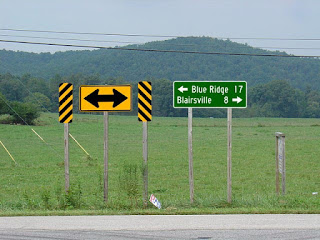
In the early 2000's this guide sign assembly was installed in Union County at Skeenah Gap Road and Old US 76. This required outside involvement to get this engineered and installed since previously the arrow sign was deteriorated and no guide sign was present. While the guide sign was not properly designed, it is closer to MUTCD compliance than the current sign. The object markers next to the arrow are also a typical state practice.

Later it was determined that the mileage to Blue Ridge was incorrect. This image shows how this could have been updated with proper routine maintenance provided through the state's traffic operations office and state-aid funding. The 72" x 24" sign would have been corrected to proper specifications and dimensions, object markers replaced with MUTCD-correct design and double arrow likewise replaced with a correct standard sign. This image, however, is a fake photo and this never happened.
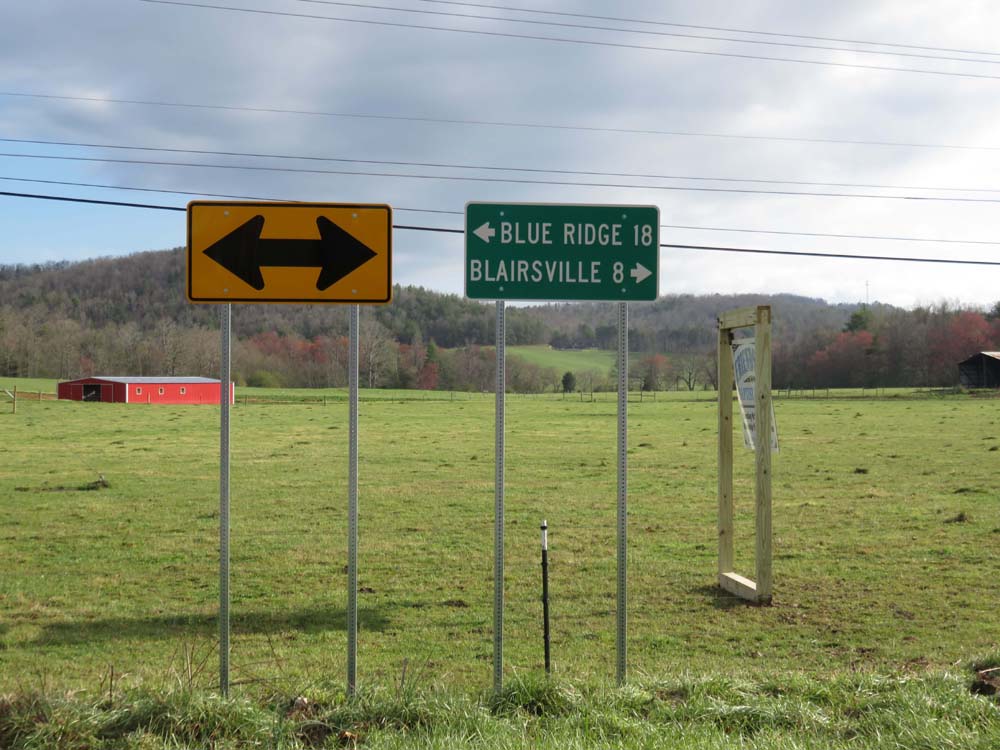
Instead, the sign was replaced "as is" except the lengthy legend was squeezed into a 48" x 24" sign. This sign is so skinny that it was impossible to make it MUTCD compliant plus the text height was reduced. The object markers were removed per decision of the engineer. While the sign on the left is correct, the sign on the right was an "as is" replacement with no effort put into properly designing the sign to MUTCD standards. If this sign had not previously existed, it would not be here at all.
Even if local governments are entrusted to put up state-funded signs as they are in states like Virginia and Maryland, guide signs are more of a statewide issue. Planning of guide signs requires an integrated approach where destinations that typically extend far beyond the local borders need to be identified with the best possible route. The state also understands connectivity and roadway classifications better than the local agencies. Thus, the duty to post any type of guide signs on roadways NOT maintained by the state should fall on the state or at least a statewide agency whose duties can be integrated to cover many counties and cities at once. This means that guide signs should always be included in any budget for local sign maintenance in addition to inclusion in the federal-aid safety projects. This also means that the duty to install these signs on any road should fall completely to the state or a regional highway agency with local governments focusing on street name signs.
Traffic studies are not always performed on these projects resulting in signs that, while MUTCD compliant in design, height and reflectivity are not properly engineered thus creating a greater hazard since they "appear" correct
Another major issue with the federal-aid safety programs is the fact that sign replacement projects often do not require an engineering study. Much of the time, sign replacement work is "as is" meaning that no matter how many errors in judgment are made by the local government or how haphazard the sign work is, all signs are pretty much replaced as they were found. Much of the funding used in both Georgia and Tennessee has included these "as is" replacements that replaced a sign that was substandard enough not to be trusted into a sign that "looks" official but is not correctly used. This endangers the public more than the prior condition due to the expectation that the conditions shown on the sign line up with conditions along the road because the sign looks official. Missing signs, incorrect curve signs such as "curve" used in a 90 degree turn and random sign work not backed by an engineering study is typical. What's worse is that these agencies have used up their available funds and think the work is adequate meaning that these conditions will likely not be corrected for years. This is not something that can be remedied when the work is transferred back to local control. The state needs to be able to oversee spot treatments and thus be able to make corrections. If a new curve sign requiring an advisory is posted incorrectly in one direction and not at all in the other, then the state will need to replace the signs on that post and put up a whole new sign in the other. Maybe they can't fix the whole roadway, but they can certainly correct any discovered errors.


This scene along Blue Ridge Highway in Union County, GA demonstrates one of those errors. While the sign is intending to say that the voting precinct is at the fire station, that is not the purpose of an emergency vehicle warning sign. These signs should have been separated and likely never will since the state is currently not in a position to point out that this is not in compliance with the MUTCD. Errors like this are not uncommon when a large number of changes are needed, and situations like this are "as is" replacements since this assembly existed in this fashion prior to this replacement. While not the worst case, it shows that traffic control decisions should be a centralized to a level where it is engineer-driven and not a localized function.

The sign above "appears" correct due to post height, sign design and reflectivity being adequate, but this is in fact a significant and unfortunately common engineering error. This is found on Gapland Road (a county-maintained road) in Frederick County, MD.
Local governments are under no obligation to either maintain to the same standards nor eventually replace these signs under another agreement. They will do little to nothing if another state administered federal grant is not provided.
The idea behind the off-system safety projects is to aid local governments, not do the job for them. When you aid somebody you do that under the expectation that they can handle the rest themselves. The problem is that is rarely the case in terms of local traffic control, so aiding them in the form of a single project every few years is not a solution. Since all but a couple states have anything near a state mandate in place, most local governments obviously are under no obligation to maintain what the state has provided in any form other than potential liability issues. Georgia and Tennessee at present have no policy in place to regulate local agencies thus permitting them to do as they wish regardless of whether the local efforts reflect sound engineering practice.

Even if the work is done so beautifully that a county road is indistinguishable from a state highway when the signs are still brand new, the fact is that this once in awhile change in signs is not typically reflected by a change in local policy. Local governments are not legally obligated to maintain what was given to them at the same levels as the state and without proper supervision will typically mess up what was done correctly the first time (such as adding speed limit signs under warning signs). When signs go missing, get damaged or wear out, the only obligation the local agency is under is liability for causing an accident due to defective signs. That is not enough of a deterrent considering that prosecution for engineering errors on a local level is rare. While those circumstances sometimes are successful, usually the local governments prove more difficult to prosecute than the state making it very easy for them to successfully weasel out of situations like this or these problems would not be so common. Most of the time older or missing signs either do not get replaced or replaced in the manner that they were first installed. Sometimes conditions on the roads change such as a new subdivision or traffic operations change that is never corrected in the older signage.
This is where the state must step in and pursue measures that consolidate that responsibility to a statewide level. Either the state DOT must begin to maintain this work for the local agencies or they (with the help of the state legislature) needs to help organize a statewide agency to do this instead. They must also penalize local agencies who fall out of compliance if they do this work incorrectly on their own. The original traffic studies should be held by both agencies, reviewed and periodically checked for compliance with modifications added for changing roadway conditions. Standards should become uniform on all levels of government, and this function needs to be centralized to make sure that a qualified agency is always on top of traffic engineering.
Funding is not committed from a state level. While there is (now) a state funding match (in Georgia), it is largely a federally-funded program

Cowan Road Connector in Acworth, GA opened in 2001. When it opened, all new signs were engineered correctly. Unfortunately, this sign demonstrates that an improperly operated local agency can mess that up. The "No Trucks" sign is not MUTCD compliant, added incorrectly under a warning sign and the warning sign itself is in need of its first replacement. While the road was engineered correctly, including traffic signs, the city did not continue proper maintenance. If the city had been under supervision of the state for traffic control, errors like this would not have happened.
Even if the work is done so beautifully that a county road is indistinguishable from a state highway when the signs are still brand new, the fact is that this once in awhile change in signs is not typically reflected by a change in local policy. Local governments are not legally obligated to maintain what was given to them at the same levels as the state and without proper supervision will typically mess up what was done correctly the first time (such as adding speed limit signs under warning signs). When signs go missing, get damaged or wear out, the only obligation the local agency is under is liability for causing an accident due to defective signs. That is not enough of a deterrent considering that prosecution for engineering errors on a local level is rare. While those circumstances sometimes are successful, usually the local governments prove more difficult to prosecute than the state making it very easy for them to successfully weasel out of situations like this or these problems would not be so common. Most of the time older or missing signs either do not get replaced or replaced in the manner that they were first installed. Sometimes conditions on the roads change such as a new subdivision or traffic operations change that is never corrected in the older signage.
This is where the state must step in and pursue measures that consolidate that responsibility to a statewide level. Either the state DOT must begin to maintain this work for the local agencies or they (with the help of the state legislature) needs to help organize a statewide agency to do this instead. They must also penalize local agencies who fall out of compliance if they do this work incorrectly on their own. The original traffic studies should be held by both agencies, reviewed and periodically checked for compliance with modifications added for changing roadway conditions. Standards should become uniform on all levels of government, and this function needs to be centralized to make sure that a qualified agency is always on top of traffic engineering.
Funding is not committed from a state level. While there is (now) a state funding match (in Georgia), it is largely a federally-funded program
Of course, all the logic presented here still comes back to funding as well. Neither the state nor the local governments want to take responsibility for funding this type of work. Instead they point fingers, refuse to budget adequate amounts for traffic safety and thus are unwilling to take charge of the problem. How can you rely on 159 counties and 538 cities in Georgia to consistently and reliably do the job correctly? Likewise how can Tennessee residents depend on all 95 counties and 346 municipalities to do the job correctly? The answer is that the state should not rely on any of them. Instead, they should create either a single statewide agency or a few engineer-driven regional agencies that are able to do that for them. They should then likewise dedicate a significant portion of state transportation funding to local traffic control relieving the counties and cities of that specific responsibility. At present, neither Georgia nor Tennessee have dedicated any state transportation dollars to local safety work other than matching the funding for federal grants.

If the states are not willing to otherwise maintain local roads, at least 1% of state highway funding should be set aside annually to finance operations of statewide or regional traffic control centers operating either as part of or independent of the state DOT. Their duties would be to pool local resources from each local agency to properly plan, install and maintain traffic control devices on roads owned and maintained by local governments while the state pays for the engineers salaries, employees and facilities. If any additional funding is available to fund traffic control on behalf of local governments in forms of federal-aid safety grants or state funding, this should be supervised by this agency not by the local government itself. Otherwise, the local agencies would be paying into it. That is what is described in the Traffic Control Cooperative Plan. The state could also expand its capacity for local traffic control by swapping low-tech services with counties and cities such as winter maintenance, summer mowing/weed control, ditch clearing and pothole patching in turn for assisting local governments in sporadically installing, replacing and correcting traffic control. Instead of paying a local agency to maintain roads on behalf of the state or vice versa, the state places the local agency in charge of specific maintenance activities in turn for equivalent payments primarily for local traffic control and traffic studies allowing funding to be adequate for most paved roads to have the majority of traffic control serviced by the state. This is what is described in the Local Exchange Plan.
At the very least, having the state government expand its traffic control responsibility to roads they do not own such as collectors and arterials would be of great benefit meaning that these efforts would not be in vain. If as-is replacements are full of errors, the state would still have good "bones" to work with in that all signs and posts in the field are to the most up-to-date standards and in good repair. At the very least they could make some adjustments to work completed in projects and add to what is there if needed.
Federal funding in this program competes for other safety funding including on the state highway system meaning the funding could be stripped away from local governments to use exclusively on state-owned roads or used for purposes other than traffic control

The signs in the image are all properly engineered and fully comply with MUTCD standards along Old TN 68 in Monroe County, TN. This road, however, had its signs in horrible condition prior to this project with few warning signs and what was left old and incorrect. The last time this road was state maintained was 1977-78 and many of the warning signs on that road dated back to that era. The county has not changed its policies, so what is the realistic chance that the county will maintain these signs to the standards they were when first installed? Slim. This is where the state should be developing a means that traffic control is not directly supervised from a local level, especially on roads like this that are eligible for federal-aid upgrades.
If the states are not willing to otherwise maintain local roads, at least 1% of state highway funding should be set aside annually to finance operations of statewide or regional traffic control centers operating either as part of or independent of the state DOT. Their duties would be to pool local resources from each local agency to properly plan, install and maintain traffic control devices on roads owned and maintained by local governments while the state pays for the engineers salaries, employees and facilities. If any additional funding is available to fund traffic control on behalf of local governments in forms of federal-aid safety grants or state funding, this should be supervised by this agency not by the local government itself. Otherwise, the local agencies would be paying into it. That is what is described in the Traffic Control Cooperative Plan. The state could also expand its capacity for local traffic control by swapping low-tech services with counties and cities such as winter maintenance, summer mowing/weed control, ditch clearing and pothole patching in turn for assisting local governments in sporadically installing, replacing and correcting traffic control. Instead of paying a local agency to maintain roads on behalf of the state or vice versa, the state places the local agency in charge of specific maintenance activities in turn for equivalent payments primarily for local traffic control and traffic studies allowing funding to be adequate for most paved roads to have the majority of traffic control serviced by the state. This is what is described in the Local Exchange Plan.
At the very least, having the state government expand its traffic control responsibility to roads they do not own such as collectors and arterials would be of great benefit meaning that these efforts would not be in vain. If as-is replacements are full of errors, the state would still have good "bones" to work with in that all signs and posts in the field are to the most up-to-date standards and in good repair. At the very least they could make some adjustments to work completed in projects and add to what is there if needed.
Federal funding in this program competes for other safety funding including on the state highway system meaning the funding could be stripped away from local governments to use exclusively on state-owned roads or used for purposes other than traffic control
Obviously state funding needs to be committed to maintenance as well as safety construction projects. It is not enough to randomly do these projects then just leave them to each local agency to do what they want with. At some point the state will need to develop a regional maintenance structure for this work to make sure it is done right, consistently and well. There is no guarantee that the off-system safety funds will always be available or that they will continue to be used for this purpose, so better maintenance will mean that millions spent for traffic studies and upgrades that seldom happen will not be in vain. Many competing needs exist as traffic volumes increase. Because of this street signs, guardrails and traffic paint will always take a low priority next to more pressing roadway projects. Thus, the state must eventually be committed to funding at least supervision of this service on behalf of local governments with or without federal-aid even if it means local governments are not making every decision. That may even require a small tax increase to achieve, but it is worth it to provide safer, less cluttered and better maintained roads.
Local governments have broad powers to choose these projects and can decide against them if they do not want to maintain costlier compliant signage meaning that some local governments with the worst conditions deliberately opt out of the program
Local governments have broad powers to choose these projects and can decide against them if they do not want to maintain costlier compliant signage meaning that some local governments with the worst conditions deliberately opt out of the program
It should also be noted that these safety projects are not a blanket improvement. Not all local agencies want to be stuck maintaining thousands of new street signs on roads where none existed before. Perhaps they feel that the state's work oversigns their roads beyond what they can afford. In Georgia's case, that may actually be true considering that the state has no policy in regards to curve warning signs in that many curves that do not pose a hazard nor require speed reduction that are signed. The fact is that many local agencies have not signed on for these improvements on any significant level. Instead, they choose to focus funding on road striping, as-is replacements, guardrail repairs or other improvements that present a lower cost to maintain and less demand. If this is no longer their responsibility, then this will become less of an issue as an engineer-driven approach will mean that a balanced and cost-efficient approach will allow even the poorest counties to maximize use of their resources. If a county has $10,000 to spend in one year and $500 the next, if that $10,000 is used only on fully compliant devices with the purchases pooled with that of many other local governments, it will stretch much further than if the county was paying for it themselves. Most local governments would likely appreciate having an agency better equipped and more knowledgeable take care of roadway safety improvements as long as they retain regulatory authority to determine speed limits and vehicle restrictions on their own and have the financial muscle to make sure that their needs are being addressed.

Many will argue that this strategy is better than nothing being done at all, and they are right. Many states refuse to delve into local matters at all, and the states taking even an indirect role in local traffic control is a huge improvement over the 1990's where state-aid in both states was limited to local paving projects and major construction. Indeed, it is a step in the right direction and a continuation of even this program will have a lasting impact that will bring both state's local systems closer to full compliance. However, it is still not an effective long-term strategy to bring an entire state into uniformity due to the fact that it does not actually correct the root of the problem. Engineering problems will still exist, maintenance will still be inadequate and the majority of local government agencies will still not be qualified to handle traffic control matters by themselves.
The reason for this is that traffic control maintenance is not a touch and go strategy. It requires an active approach that local agencies simply have not done well enough to be entrusted with. While local control has many benefits, the cost to local governments for safety improvements is simply too high while the need is too low for it ever to take adequate priority. Because of this, states as a whole, including the two state examples here, need to expand this program by funding regional traffic control cooperatives that not only place the authority for off-system safety projects under their jurisdiction, but also place maintenance authority for traffic control on local roads with them regardless of the level of funding provided by the local governments for that purpose. States like North Carolina, Virginia and Delaware have demonstrated that even with tight budget constraints that a centralized strategy to traffic control is not only very effective but may actually reduce overall costs. Likewise, it is not acceptable to place technical matters in the hands of a small local agency without any staff engineers or purchasing power with the expectation that this is something they will be able to handle well. Such duties must be collectivized into larger units to be effective whether it be the state government or a statewide cooperative. Overall, states are better trained, better organized and better able to absorb costs like this far more easily than a local agency that is sensitive to population, unit costs, politics, income levels of residents and capacity.

A dangerous S-curve was improperly signed in Dawson County, GA after the county opted out of sign work for their county roads instead using the funding only for pavement markings. This is a typical error with the curve misidentified (winding road) and instead of posting an advisory speed and chevrons they resulted to this redundant and useless sign. The road here, Steve Tate Road, is a major collector meaning that it is potentially eligible to be a state route and carries according to GDOT state highway-level traffic yet the road is treated far less important.
THE VIEW OF FEDERAL-AID SAFETY GRANTS OVERALL
Many will argue that this strategy is better than nothing being done at all, and they are right. Many states refuse to delve into local matters at all, and the states taking even an indirect role in local traffic control is a huge improvement over the 1990's where state-aid in both states was limited to local paving projects and major construction. Indeed, it is a step in the right direction and a continuation of even this program will have a lasting impact that will bring both state's local systems closer to full compliance. However, it is still not an effective long-term strategy to bring an entire state into uniformity due to the fact that it does not actually correct the root of the problem. Engineering problems will still exist, maintenance will still be inadequate and the majority of local government agencies will still not be qualified to handle traffic control matters by themselves.
The reason for this is that traffic control maintenance is not a touch and go strategy. It requires an active approach that local agencies simply have not done well enough to be entrusted with. While local control has many benefits, the cost to local governments for safety improvements is simply too high while the need is too low for it ever to take adequate priority. Because of this, states as a whole, including the two state examples here, need to expand this program by funding regional traffic control cooperatives that not only place the authority for off-system safety projects under their jurisdiction, but also place maintenance authority for traffic control on local roads with them regardless of the level of funding provided by the local governments for that purpose. States like North Carolina, Virginia and Delaware have demonstrated that even with tight budget constraints that a centralized strategy to traffic control is not only very effective but may actually reduce overall costs. Likewise, it is not acceptable to place technical matters in the hands of a small local agency without any staff engineers or purchasing power with the expectation that this is something they will be able to handle well. Such duties must be collectivized into larger units to be effective whether it be the state government or a statewide cooperative. Overall, states are better trained, better organized and better able to absorb costs like this far more easily than a local agency that is sensitive to population, unit costs, politics, income levels of residents and capacity.