Monday, February 9, 2015

Shoddy Signs Spotlight: Morgan County, AL

Morgan County is a moderate population county located to the south of Huntsville.  With 119,490 residents, the unincorporated county has over 40,000 residents with its largest city Decatur dominating the county in population serving as a bedroom community for Huntsville.  Considering its population, most people would think that traffic safety improvements would be excellent.  They would be wrong.  Quite possibly no county has surpassed Morgan County, AL in atrociousness when it comes to traffic sign standards.  This is unfortunate considering that the county otherwise appears to otherwise have an excellent road system.


The first photo is on Lando Cain Road southbound where it transitions into East Byrd Road via a 90 degree turn.  This atrocity is what you see as you come up to that dangerous turn.  A street name sign is posted on top of the curve sign for a particularly confusing experience.  Additionally, a single off-center chevron with the curve sign in the middle of the sharp turn are all that greet drivers.  There should either be at least two chevrons visible from each direction or large arrow signs (W6-6). Westbound in the second photo only a (very incorrectly designed) curve sign is posted.   As to the curve signs, this appears to be a contractor purchase that wasn't inspected to make sure that what they were buying was MUTCD-compliant.  Granted you could shoot into either driveway if you miss the curve, but most drivers would be close to highway speed before being surprised by the severity of this curve an otherwise arrow-straight road.  Because of that, the risk of hitting a car coming from the other direction is pretty high (Photos from Google Street View, June 2014).


This is the intersection in question from Google Maps

The issues with the signs are quite numerous.  Extremely poor traffic engineering is the tip of the iceberg.  The design of nearly every warning and regulatory sign is completely wrong, maintenance is poor, post height is incorrect and what signs exist are rather sparse.  Furthermore, county routes still appear on maps, but signage has completely disappeared even though these county routes have not been assigned or posted with names.  Street name signs also do not meet MUTCD standards and do not include cross-street names meaning traffic coming from a side road will need GPS to even know what road they are approaching.  How can a county that otherwise has smooth, well-built roads have such poor management of traffic signs?  This is the county paradox, and this is why safety improvements as a whole are something that should typically not be handled from an individual county or municipal level with exception to a few high income, high population areas.  Reason would say that you would be punishing the ones that do it right, but clearly self-policing does not work, and if those "good ones" know something that this county does not, then that knowledge needs to be shared in a way that changes are permanent and for the better.


These winding road signs are just two examples of poorly designed signs pandemic around the county.  Both are atrociously designed and do not comply with the MUTCD located on County Road 55: a major collector road.  Note that the post height is less than 5' on the first sign and that both signs are 24" x 24" on a major road with a 45 MPH speed limit (both signs are required to be 30" x 30").  Also note that the road curves to the left.  This is actually a left reverse curve, not a right winding road.  The second sign was witnessed in other counties suggesting a contractor that was not properly vetted for compliance.  The first image is on CR 55 eastbound west of Fowler Road and the second on CR 55 westbound west of Chambers Ln (Google Street View, September 2013).


Curve in question on Google Maps.  It's fairly obvious from here it is a left reverse curve not a "winding road".

It should be noted that this county does have an engineer, and this engineer clearly has no interest in this aspect of the county road system.  However, is this engineer a PTOE?  Alabama has provided county engineers, but nobody like this for traffic control.  Otherwise, it would be much better.  Obviously no traffic study has been conducted on any of these roads or there would be advisory signs under the curve signs, signs would be posted at the correct height, signs would be in the correct place and the signs would look like standard signs.  If nothing else, an engineer's right to oversee any county road system when funded by the state should rest on the engineer's compliance with state standards for safety improvements, but preferably the county engineer should not be wearing "many hats" with something like traffic control being a side job, which is clearly what is going on here.  Clearly Alabama has no mandate that counties and cities follow these standards despite providing ample funds for this purpose.  Since Morgan County was not a captive county, there was also never at any recent time any state help to upgrade these signage deficiencies.   To fix this problem, it would be best to be handle this problem from a state level or regional level.  Could it be fixed from a local level?  Partially, but it's doubtful that the efforts would be enough to truly correct the issues.  It did appear some newer signs were more compliant, but that's not enough.

WHAT THE STATE SHOULD DO

It is very clear that Alabama needs to change its approach to county roads.  With counties and cities unwilling to consistently and effectively engineer and maintain roads, a greater state role is needed.  According to "Implementing the High Risk Rural Roads Program by the FHWA" on page 16 it states, "Alabama trained county engineers in data analysis and low-cost safety improvements. Alabama dedicates all HRRRP funding to qualifying municipal and county roadways. In the first year Alabama divided available HRRRP funds equally among the State’s 67 counties as they developed a specific procedure. In coordination with relevant stakeholders, including local agency representatives, ALDOT developed a process requiring county engineers to participate in data analysis and low-cost safety improvement training to qualify for funding."  If that is so, then why aren't the traffic signs in far better shape?  This Alabama approach isn't requiring them to do anything or show any results.  This program didn't really require any real changes at all.  A few small areas look to have been improved, but no major changes have been made with this program.  It also appears that Alabama has not really worked to identify these issues on a state level meaning it's up to the counties to regulate themselves.  In addition, the lack of a "qualified vendors list" for traffic signs does not provide any means for local agencies to screen private vendors.  Many other states have this, including Georgia.  These counties by and large appear to have used this funding for other issues not related to traffic control devices.  Neither are any quality controls in place for those local agencies assigned with this task to assure that the best materials are being used.


Community Lane just west of Gum Springs Road in the northern part of the county did not disappoint with terrible signs.  The Stop Ahead sign and the reverse turn sign both have undersized, incorrect symbols on posts only about 2' off the ground.  While the conditions are correct, the signs are not.  The reverse turn sign should also have an advisory and either chevrons or arrows on the turn ahead (which it does not).  (Google Street View, June 2014)

A start would be for Alabama to carbon-copy Georgia's "Off-System Safety Improvement Program".  This program requires little to no local investment, demands state standards are followed, uses state forces to identify problem areas and takes this work out of the hands of local engineers.  Some GDOT districts have also hired private engineering firms to conduct traffic studies for these safety projects meaning that roads in many, many counties that have never before had any traffic study nor were in compliance with MUTCD standards have been able to have their safety issues corrected to where they meet or exceed standards found along state highways.  By privatizing the process, Georgia took the work out of the hands of counties who were not doing the job right.  While Georgia's county road agency structure is different from Alabama's, the state finally understood that technical issues are best addressed outside the scope of local politics at least for the purpose of distributing federal funds for safety improvements.  Georgia's approach by no means has been a cure-all nor has it necessarily corrected local maintenance deficiencies after projects are completed, but it gives local governments a chance to do something well that they were unable to do very well before by showing them how to do it the right way and making sure that funds are spent in a way that brings local signage into compliance with state and federal standards.  How well these are ultimately maintained in the future, however, remains to be seen as currently no structure is in place to provide statewide or regional traffic control services to local governments.  This latter situation is quite similar to Alabama, but the former situation has placed Georgia well ahead of Alabama.


South Cedar Cove Road transitions to North Cedar Cove Road in what is a sharp turn even less than 90 degrees.  With that much of a hazard, the only thing posted is an undersized and non-standard turn sign (no advisory) and two chevrons stacked at one point in the curve.  If nothing else, large arrows should be stacked and better warning signs should be posted.


The curve in question from Google Maps

In addition to centralizing federal-aid funding, the best strategy by far is the development of a regional traffic control district.  This can either be a decentralized model based on planning regions or a centralized one that operates as a local arm of ALDOT.

Regional Traffic Control District: Planning Region Option

The first option is to take traffic control out of the hands of the county engineer and replace it with a more centralized program where traffic engineering is a multi-jurisdictional operation jointly funded by multiple counties and cities across a larger region.  It is important to note that the region is very rural and that by itself that Morgan County would still not have adequate population coupled with its own planning region (North-Central Alabama Regional Council of Governments), but if combined with the NW Alabama Council of Local Governments, this would bring the region up to eight counties with a population exceeding 500,000.  Could Morgan County then afford a PTOE?  Of course.  If every county and city participated, the cost of a PTOE would be less than $10,000/year for Morgan County alone!  The idea is that a regional traffic control operation separates that responsibility from the county engineer so that resources can be pooled enough to fund an agency whose sole purpose is traffic control planning and maintenance.  Clearly the county is not able to do it alone, but when coupled with so many other cities and counties, a benefit that was lost when the "captive county" program was eliminated will not only be given to Morgan County, but will return to five of the counties in the region that used to be part of the captive county system up until 1979.

This top-down approach would create an umbrella regional agency operating as a superlocal division of state government whose sole responsibility is traffic control for multiple counties and cities large and small allowing resources to be pooled to a point that a "state within a state" would replace ineffective and substandard traffic control like this.  However, the fact that such an approach is untested means it will be difficult to establish.  Will a bunch of neighboring counties be willing to share a service like this?  This is why this was not offered as the only strategy.


Nearby to Cedar Cove Road, Gum Springs Road has this infamous combination of speed limit doubling as advisory sign and curve sign screw-up like what was seen on County Road 55 (Google Street View, June 2014).

Regional Traffic Control: State-Administered Option

Another option to consider would be using the state government to make this happen.  This can be done one of two ways:


  • The Contracting Method: An individual county or city basically pays a fee to ALDOT to have the state administer their local traffic control program. 
  • The Statewide Cooperative Method: The state legislature or state DOT sets up an umbrella agency separate from ALDOT where local agencies pool resources to provide statewide oversight of local traffic control by becoming "members"

Both plans in the second option have in common an operations fee, but on either plan the state can finance the operations alone and can thus waive the fee allowing poorer counties to avoid any excess costs to fund professional services.  In the planning region option, the operations fee cannot be waived, because the operations are self-funded by every member local agency.  In contrast, the state-administered option has the operations fee dictated by ALDOT with the fee used to add on any necessary employees, equipment or facilities to the existing state operations.  Any additional funding provided by the local agency must be returned in kind by the state in labor and materials.  The second plan is basically functions like a bank in that each participating local agency is a member and deposits money that can only be used on their roads.  However, this "bank" has an operations fee which is used to finance facilities, equipment, staff engineers and other employees whose sole purpose is to plan and maintain traffic control on local roads in all member counties and municipalities.  If the state decides it is able to cover it, that would remove all barriers to poorer rural counties, right?  ALDOT would not own this agency, but would be provided some regulatory oversight.  The second option would most likely require the creation of an elected position to keep the activities of the cooperative accountable to the voters.

On Option 2, the important thing to consider is the potential for permanence in such a situation.  Would the state commit to this plan long term or ax it when the budget got a little too tight?  The cooperative model is more stable, because it operates outside the realm of ALDOT or the legislature.  In addition, the idea with either plan is not to shun the private sector.  For instance, in the ALDOT plan the strategy would most likely be that the state plans all traffic control and requires local agencies to purchase from a list of qualified private vendors pooling resources for any large purchases.  The state may provide certain materials at a price to the local agencies such as guide or route signs, but the majority of signing materials would come from private vendors.


What drivers actually see approaching a long S-curve with a hidden intersection in the curve on County Road 55 eastbound approaching Patton Rd. (Image from Google Street View, June 2014)


What drivers should be seeing.  The signs in this image were added to the street view image slightly further west.  Advisory speeds were not included in this image since it is unclear what they would be if used.  A W16-8 street name sign was included underneath the W2-1 cross road sign for Patton Road and Moses Road so that drivers would not have to slow down to read the street names in a curve.  Yellow "signposts" were used to make them more visible in the image.  A close-up of the W16-8 sign is shown here for better visibility.


Here is the area shown on Google Maps.


Here we have OZ Davis Road east of Old Eva Road.  A local connecting road, it has a very sharp reverse turn with no signs whatsoever approaches travelers westbound at the end of a 3/4 mile bee line.  Having an appropriate independent engineering study would locate and correct missing signage like this.  Since no speed limit is posted, this is essentially a basic speed law road.  (Google Street View, June 2014).


Area in question along OZ Davis Road.  The trailers visible in the Street View image above are in the lower middle of the aerial image for reference.


In another case here, a dangerous curve with a hidden intersection passed it is noted on Nat Key Road and not even marked at all.  The latter image took the Street View image and added appropriate warning signs designed to be at proportionally correct heights.  Some specific ALDOT standards were incorporated as well such as the object marker under the arrow sign and the oversized advisory speed sign.  The yellow posts are not specifically ALDOT standard, but are used to show how these could be yellow-painted for greater emphasis. (Google Street View, June 2014).


Aerial image from Google Maps showing the sharp curve and intersection as shown above.  The image is just east of the sharp curve on Nat Key Road with Gibson Road in the middle.

Summary of the Two Plans

In all options, the county's direct involvement in planning, designing and installing traffic control devices is eliminated, but this does not necessarily mean local funding is eliminated.  What changes is the management of the devices entrusting it to authorities better trained and suited to handle such matters with a more disciplined approach to engineering standards.  It is clear from these images that enforcement of MUTCD standards is not a priority for the state, but if the responsibility was centralized to a certain point, it would create conditions where instead of the liability falling on the county or state, it would fall directly on a licensed PTOE whose career is on the line if the signs are not designed and maintained correctly.  This is the only enforcement mechanism, and this needs to be done: traffic control should be placed with an authority whose SOLE PURPOSE is traffic control and who has a vested interest in making sure it is handled the correct way every single time.  Morgan County is not doing this, and apparently they have little vested interest in the quality or consistency of traffic control.  Unfortunately Morgan County is one of many counties and municipalities across the nation with this attitude.  Public safety is simply not important enough to invest heavily in traffic control, and part of that is that nobody on a county level seems to understand the problem well enough.


County Road 55 in Eva has this completely incorrect speed limit sign in Series B.  Eva is a city, but mostly contracts road maintenance to the county.


County Road 55 east of Nat King Road has yet another Series B speed limit sign that appears to be 1 foot too low considering the sign is down slope from the pavement.  The original and then the correction (fake) is posted just below it.  (Google Street View image, June 2014).  
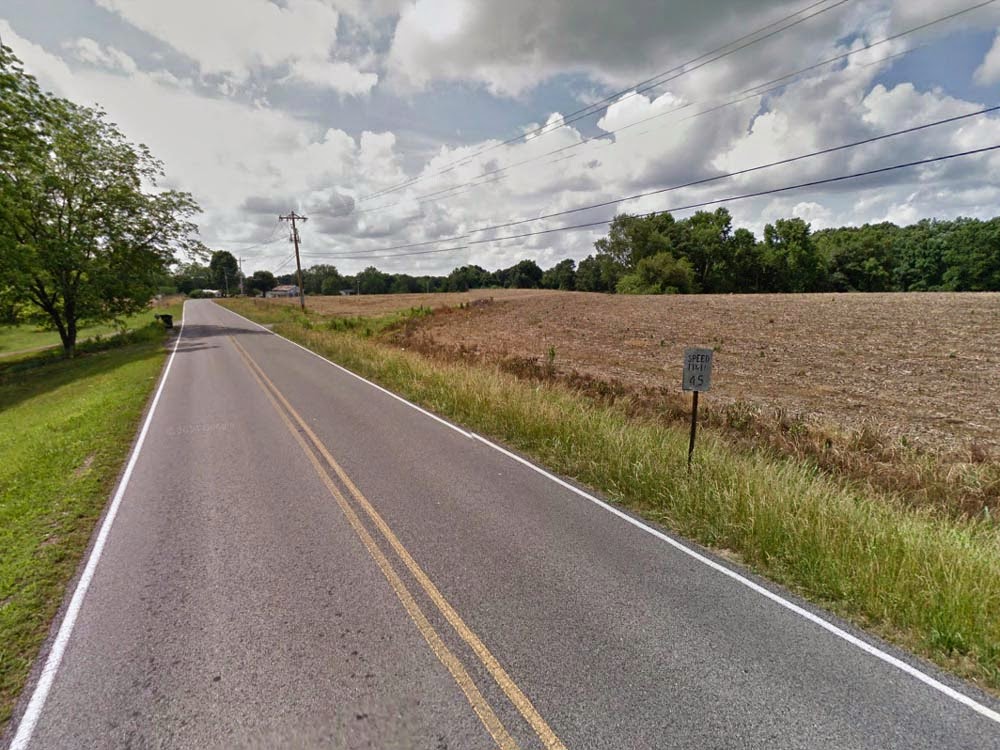

The above sign, also on County Road 55, is even worse and is in disrepair.  It is located west of Union Hill Church Road.  Except in the instance of a kangaroo court, this sign cannot even be enforced if found to be defective, because it is not considered a traffic control device.


The last one is the worst one.  Not only is the speed number smaller than the words "SPEED LIMIT" but the sign is also barely two feet off of the ground.  This one is located on Indian Hills Road north of Bethel Road in the NW part of the county.  


Bridge rail issues are pretty typical in low budget states with a poor safety investment.  While an interesting historical novelty, it should be pretty clear from the damage on both rails that these antiquated designs pose a serious hazard to motorists.  The two safety plans proposed on a state level should help better fund corrections to this.  The first is on Robinson Creek Road over Flint Creek.  Two other bridges to the north are low-water bridges with no railing.  The second is on Nat Key Road over Robertson Branch.  Strangely the county does not seem to have as significant issues posting object markers on bridges as they do with other signs, but the posts need to be leveled out to be more effective.


At this location on Robinson Creek Road just west of Appleton Road, pipes run close to the roadway without any adequate safety devices in place to warn drivers that they could drive off into the creek.  A flood gauge is also needed here seeing that this is a low area.   This road is otherwise unpaved.  (Google Street View, June 2014).

However, none of these plans can be brokered without broader support from the state legislature, key local officials and/or discussions among many counties and municipalities that evolve into a regional and/or statewide agreement.  Like every other county in the state, local authority for routine maintenance would transfer to regions pretty much eliminating issues like those that exist in these images.  On the second and third plans especially, Morgan County would no longer have any excuse for the deplorable condition their traffic signs are in.  With the expanded purchasing power created by sharing this responsibility and professional expertise available to point out problem areas, the funding available would be more than sufficient to correct every deficient sign within 5-6 years even without any any federal funding used.  Essentially the situation with the defective and incorrectly engineered traffic signs is not just a failure on the part of the county, but also the state to not provide any dedicated funding, programs or oversight to make sure that local efforts were matching state efforts.  This plan is designed to correct that.


What drivers see as they approach the CR 73/35 junction in Eva on CR 55 westbound.


What they should be seeing.


The curve above in Eva is actually a very sharp left turn where CR 55 turns at Morgan Drive to junction with Eva Road (shown here as CR 35).  The signage is clearly negligent considering that this is a sharp turn left needing an advisory, turn instead of curve sign, large arrow signs, a stop ahead sign and a junction route assembly for the approaching county highway.


The "curve" here is actually the beginning of a winding road on a downhill section of County Road 55 westbound.  Most likely the county did not have a winding road sign that day when it came time to replace it.


The last is on Nat Key Road marking a very sharp winding road section where another "drunken" winding road sign without an advisory speed marks the curve.  (All images from Google Street View image, June 2014).

WHAT THE COUNTY SHOULD DO

Traffic signs like you see on these roads make driving these roads significantly more dangerous especially in adverse weather conditions such as rain, fog and during the nighttime.  Morgan County could do much better, and the county could and should do this with or without any cooperative efforts.  In all, they should take a multi-faceted approach to correcting this problem with or without any state help at all.  Here are the most steps the county needs to take with or without the development of a cooperative region:

  1. The county needs to consider consolidating the county's traffic sign program with the county's seven cities. This will help to pool resources so that safety work can be coordinated, costs can be reduced, facilities can be consolidated, equipment purchased more cheaply with standards subsequently raised.  This could also open the possibility for the hiring of a PTOE and development of a countywide traffic operations unit allowing the county engineer to focus on other matters.
  2. The county commissioners need to recognize that this is a big problem creating substantial local liability. 
  3. The county commissioners should redirect funds into a significant investment on a local level to fix these problems.  This includes the hiring of a private engineering firm to perform traffic studies on all federal-aid eligible roads (arterials and collectors) that are under county control followed by remaining paved roads with costs to be spread over a five year period.  These studies need to identify the proper locations and types of warning, regulatory, guide and route signs needed.  Traffic studies should include roads in cities where Morgan County is responsible for road maintenance such as Eva.  HRRP funds should be used to finance this part of the process.
  4. Morgan County needs to budget at least 2% of the county budget for traffic safety improvements until all traffic signs and pavement markings are brought to state and MUTCD standards.
  5. Morgan County needs to adopt ALDOT standards for traffic signs, guardrails and pavement markings on all county-maintained roads.
  6. Major reform is needed in traffic sign standards.  Employees need to be formally trained in proper design, installation and maintenance of signs according to the MUTCD, Standard Highway Signs manual and state standards.  Post height needs to be corrected, signs need to have correct dimensions and symbols and fonts need to match drawings in the Standard Highway Signs manual.  This is a training matter that does not require a full-time engineer.
  7. The fabrication of signs in-house other than street name signs should be suspended until newer and better equipment is purchased.  This new equipment should have all proper fonts, MUTCD signs and plotting equipment.  An independent PTOE should review and recommend materials purchased.
  8. Vendors who have sold traffic signs that fall below MUTCD standards should no longer be used.  It needs to be recognized which signs are not correct with signs removed as soon as possible.  If possible, the county should request from ALDOT a qualified vendor list.
  9. The original statewide county highway system should be re-established in the county with routes posted along major county roads.  Numbers should match those as assigned originally by the state.  These should be signed within city limits of cities and towns using county funds (e.g. County Road 55).  
  10. Directional and distance guide signs should be installed at the junction of major county routes with other major county routes and state highways.


The above shows yet another county error.  It's possible the city of Eva paid for these guide signs even though the county otherwise maintains their roads.  While they are genuinely helpful, they are non-compliant, difficult to read and in a poor location.  The image below shows what is needed instead, and the Google Earth edited image below shows how the intersection should be laid out based one direction.  Guide and route signs like this are needed county-wide along major county roads like these.  (Google Street View, June 2014)


The annotated drawing here with aerials from Google Earth relates to the images above.  This shows the needed route and guide signs along major county road intersections.  Both roads shown here are major collector routes.  Also note that CR 35 is shown as CR 73 on the ALDOT functional classification map but likely was originally CR 35 when the state-numbered system was still intact.

Many other counties and cities across Alabama have adequately addressed their sign issues simply through sufficient interest from the county engineer.  It is unfortunate that Morgan County has not taken this approach.  It is hoped that the county commissioners will see this and take the steps necessary such as these recommendations here to review and overhaul the county sign program.  While the county sign issues need specialization from a PTOE and traffic operations unit, at the very least some smaller steps can be taken to improve on what is already there by simply reviewing existing conditions and comparing them to MUTCD standards.  Instances such as a post height of less than 5 feet, typical signs that do not match Standard Highway Signs manual, a winding road sign for an obvious reverse curve and omission of signs in obviously hazardous conditions are all conditions that are simple to fix and do not require an engineer: they only require a commitment from the local government and local authorities to identify and replace.

CONCLUSION

Morgan County was chosen for the spotlight to highlight that issues with MUTCD compliance (traffic control devices) do not necessarily relate to either population or even access to professional engineers.  Morgan County has the population and funding to do a far better job than they're doing, and this is why requiring counties and cities to have complete control of this and other safety improvements that typically require the supervision of a licensed traffic engineer with a PTOE certification endangers the traveling public and constitutes a misuse of public funding.

This was a longer post to highlight that a local hands-off approach is not an effective solution even if counties and cities are provided with engineers and have the population to do it.  If 50% of the counties in the state do a good job and the other 50% are not, then why should the 50% that are doing it correctly bother if the others can do as they please?  Fixing the problem is not even about punishing the "good" counties: it's about recognizing that a failure in even one county or municipality constitutes the need for systemic reform.  It also highlights the weaknesses of self-policing when it comes to public safety.  While ALDOT or the legislature stepping in might better fund this problem, the only real way to put teeth into local practices is to remove the supervision of this responsibility from the local governments itself placing it instead with regional cooperatives who are able to do it well.  Nonetheless, counties and cities statewide can also do this themselves by realizing that local control is not always best when it comes to routine maintenance thus combining that responsibility into a statewide cooperative to pool resources, consolidate purchases and improve engineering standards.  Traffic safety devices are not a "small part" of road maintenance.  They are a very big part and should not be mishandled just to pave an extra road or two.  This post highlights the problem while recognizing that the problem is deeper than just the local government: it recognizes that this is a function best handled when that responsibility is handled collectively across many jurisdictions in order to establish adequate resources and supervision.

Thursday, February 5, 2015

Traffic Control Cooperative Plan: Horizontal Multi-Agency Cooperation For Better Safety

State And Local Road Reform has already presented the unique "regional roads" proposal, but this proposal takes that idea and strips it down into a more specific strategy that requires no mergers of any highway agencies.  While most of these proposals are targeted at creating more efficiency as part of improving unsafe road conditions, the Traffic Control Cooperative Plan stands out as being the most simple to institute.  This plan simply involves the development of a cooperative where multiple counties and cities pool resources expressly for the purpose of planning, purchasing and managing traffic control devices on roads otherwise owned and maintained by their respective local governments.  While this plan can be brokered or even operated as part of the state DOT, the idea with this plan is to help local governments help themselves.  This plan is also designed to improve maintenance output on a local level at a minimal cost due to the tremendous economies of scale.  It is also designed to mostly eliminate MUTCD non-compliance issues along local roads.  No jurisdictions change and nothing else changes other than responsibility for traffic control and roadway safety devices.  While the plan is not a stepping stone to regional roads, it can serve as a low-cost litmus test to see if local agencies can cooperate well enough to transfer certain roads or certain local networks into a full-fledged regional system.

The purpose of this plan is to target specifically the weakest area in local road maintenance.  It is clear looking at the various county and municipal road systems in many states both rural and urban that the problems these agencies face have nothing to do with the local economy as much as they have to do with poor economies of scale.  Funds cannot be leveraged enough on a local level in most of these political subdivisions to provide either proper supervision nor frequent enough maintenance, and in the case of either counties or townships the ability to grow through expansion of territory is impossible.  While cities may grow either way, most cities have very small populations, few roads and small geographic areas making them unsuitable stewards of traffic control operations.  While local road funding is ample to keep roads smooth and bridges in good repair, the funding provided by the state or local sources to hire engineers, develop sign shops and purchase costly equipment to install/maintain signs and other traffic safety devices typically is not.  The former is usually done on a contract basis usually through grants, but this is a day-to-day operation with annual outputs often of as little as $5,000 per year.  That is just enough to install or replace a few street name and stop signs.  The irony is that an amount that little may be acceptable if that cost is shared among many other jurisdictions while a jointly-funded qualified engineer is able to lay out the true cost needed to each partner agency.


A road can be in good repair, but that doesn't mean it's well-maintained when safety improvements are poorly maintained.  This plan hopes to correct that.

Unlike other maintenance agreements, this plan covers all jurisdictions regardless of size or function (county or municipal).  This means that all types of jurisdictions of all sizes can realistically participate without tremendous disruption meaning everything from large cities and counties to very small townships and counties with more farm animals than people.  This program is also funded independent or in addition to federally-funded sign programs in that it is exclusively local or state-funded and is guaranteed to every county and municipality annually.  Payments are not made directly to local agencies, however.  Instead, a budget is determined to cover the operational costs of the work at the beginning of the fiscal year which is financed either by the state or proportionally by each member agency based on population ratio.  Unless a dedicated funding source exists separate from local agencies, funding also comes directly from the local governments.  Consider the $5,000 amount.  That $5,000 would most likely be divided up for operational costs with the rest put into pure maintenance.  Even if the local agency had to increase funding to cover the operations fee, it would not be much and would return in far greater maintenance output than the previous year as that available funding would be able to stretch further when combined with other projects.  When the local agency does not have to pay for any traffic studies directly and is able to stretch that budget for stop and street name signs much further, this means that sharp curves can be properly marked and that wrecked guardrail near the fire station can be finally repaired.

Two principal methods to administer this are possible: as a state agency operating separate from the state DOT with limited state funding that allows local governments to avoid an operations fee and as a true cooperative where every member local agency shares the costs horizontally with the financial and structural capabilities limited by participation.  Generally the second option will require a moderate to high level of participation of more populous cities, towns and counties or a very high level of less populous cities, towns and counties for it to work.

OPTION 1: STATE AGENCY METHOD

The first option involves the expansion of the state DOT for the purpose of local traffic control, but with NO additional costs incurred by the state DOT itself.  In essense, the state DOT develops an internal cooperative for the purpose of providing local governments the option of contracting with the state for traffic control if they are willing to pay an operations fee and provide their own funding for any labor or materials used by the state on local roads.  Doing it this way, the state already has all of the infrastructure in place to expand their services, but any needed expansion of services or employees needed to administer this work on behalf of local agencies must be funded by the combined deposits from the operations fee.

Picture that a state has 100 counties and 300 cities and that 25 counties and 100 cities choose to participate.  The state decides the operations fee should be based on population ratio and sets a budget for the operations fee.  Let's say they budget $850,000 for the operations fee based on participation out of a population of participating agencies of 1.25 million (meaning $0.68 for every person).  This means that a county with an unincorporated population of 25,000 residents will be expected to pay a $17,000 operations fee (far less than the cost of hiring a consultant or county engineer) coupled with whatever they wish to contribute to finance traffic control.  Let's say the county has budgeted $50,000 for traffic control in a given year (signs, striping and guardrails).  They may budget $5,000 the next year, but they can stay on as long as they pay the fee.  Thus, the total for the county in question is $67,000 for the first year and $22,000 the following year.  It should be noted that the operations fee may be too high for just traffic control alone in rural counties, so the state may expand the option for rural counties to be provided all engineering services out of that operations fee thus allowing the entire county road maintenance operation to be overseen by the state DOT.  While this would not transfer ownership to the state, it would transfer supervision of all routine maintenance to the state.

What would agencies partnered with the state DOT receive?  They would receive:
  1. State DOT engineering and oversight of traffic control devices and safety improvements on local roads (roads not maintained by the state) is given partially or exclusively to the state traffic operations agency 
  2. The safety improvements that fall under state funding and supervision include the following items: 
    • traffic control devices (signs, delineators)
    • traffic signals
    • pavement markings (road striping, rumble strips, raised pavement markers)
    • bridge rail repair
    • traffic signals/street lights and 
    • guardrails (installation and repair).
  3. While the initial plan is for local agencies to fund the operation entirely, the operations fee might be an issue for smaller local agencies.  The state DOT should set aside an amount adequate to waive the operations fee in order to provide this service dollar-for-dollar meaning that if the local agency is willing to spend $10,000, the state provides the local agency exactly $10,000 worth of work.  However, unless the local agency was specific on how those funds are spent, the state may use those funds at their own discretion.
  4. The state DOT may create a requirement of full transfer of engineering responsibility to the state in rural counties and smaller cities if the operations fee is too much of an issue for just traffic control meaning the entire operation falls under state DOT supervision.
  5. Either state forces or in some cases county forces under state supervision install and maintain traffic control devices along local roads
    • if the county or municipality has the needed equipment, they may do this work themselves, but the state agency will be required to have the equipment and will generally provide this service for any local agency that lacks the equipment to do so
    • a local agency doing this on behalf of the state will be reimbursed the cost difference
  6. If a local agency produces or purchases their own devices while under state supervision, all devices must be purchased through state-approved vendors and comply with state and federal/MUTCD standards.  The state will have the right to inspect any work the local agency does as part of the agreement.
Local Example

Each local agency in this program is budgeted a certain amount for traffic operations improvements.  Funding to each local agency is based entirely on ten year census population of the local government agency divided by the state population.  Here is an example in a fictional Cass County:
  • Cass County has a population of 25,000
  • Cass County has two municipalities with a population of  2,000 in the first and 500 in the second (Hankston and Porterdale) meaning unincorporated population is 22,500.
  • Cass County is in Sample State with a population of 5 million
  • 45 of the states 75 counties have contracted with the state DOT with a total combined population of about 1.7 million
  • The state has determined that the operations fee should be $0.50 per person (based on census population)
  • The total operations fee budget is then $850,000
  • Cass County's population ratio of the participating agencies is 1.3%
  • Thus, Cass County's portion of the operations fee will be $11,250
  • The county typically budgets only $10,000 per year on traffic control, so it is determined that the county should just contract their entire engineering responsibility to the state effectively putting routine maintenance of county roads under state supervision.
  • This means that Cass County has retained ownership of roads and is in charge of funding, but has entrusted a portion of the roads budget to the state DOT in conjunction with the operations fee paid annually. 
  • Both Hankston and Porterdale participate.  Their operations fees are $1,000 and $250, respectively
  • In a single year, the cost savings from the partnership allowed Cass County to afford to install or replace 200 traffic signs, repair two miles of guardrails, and restripe three roads due to the county's low population.  Previously the county was only able to afford to do about 1/4 of that on the same budget.
As seen in the above, a county that likely would have had difficulty budgeting this work on their own has been aided significantly with the annual state payments while also paying back some of the administrative costs for the state-aid work.  Since each local jurisdiction would be paid annually based on a fair formula, there is no competition for funding.  Distribution of funding is distributed evenly based on population of the local jurisdiction divided by the state population, but could also be tweaked to include road mileage as a factor.  Local jurisdictions would also no longer feel unable to maintain traffic signs or pavement markings since the state would be providing annual funding.

The federally-funded High Risk Rural Roads Program should not be ignored in this plan.  While not all states use those funds for that purpose, funds from that program should be used in addition to state funding for this program not in lieu of it.  Where the state may have difficultly raising money for higher cost improvements such as extensive guardrail replacement, complete sign overhauls in a single county or city, road striping upgrades or engineering work that exceeds the state's resources, this program will greatly speed up the process and reduce the costs on the state needed to execute a program like this.

Drawbacks to Option 1

The main problems with using the state DOT directly has to do with the state's lack of willingness to finance this program, liability that comes with it and the state placing lower priority on roadways off of the state highway system.  While it will still be far better than the current system, participation is voluntary and the state DOT would be free to pull back on this program at any time even though they would not be responsible for funding any part of the operation.  It would have to be clearly written in state law that any local agency willing to partner with the state could not be turned down and that the program was made permanent by state law.  Nonetheless, a court decision could quickly revert this method back to status quo.  With states wanting to reduce their direct responsibility, this is why Option 2 was added to the original plan.

OPTION 2: STATEWIDE TRAFFIC CONTROL COOPERATIVE

The second option differs from the first option in that authority for traffic control is NOT handed to the state DOT, but instead is entrusted within a brand new statewide organization whose sole duty is to supervise and provide traffic control and traffic safety improvements on roads otherwise owned and maintained by local governments.  Funding comes from sources independent of the state DOT and the regional authority works exclusively for local governments providing traffic control on behalf of all of the counties and municipalities.  In this option, the cooperative may be created either by the state legislature or by a collective agreement by more than half of counties and cities across the state in what is equivalent to a statewide special assessment district.  If created by the state legislature it is a state agency.  If created as a local agency cooperative it is a statewide agency, but not a state agency.  Either way, the cooperative is not part of the state DOT although it has some powers equivalent to a state DOT.  It could perceivable begin as a regional traffic control pact that expands to cover most or all of a single state.  It could also evolve into a statewide local roads authority that expands its operations to provide full road maintenance to any counties or municipalities who feel that they are better suited transferring the entire operation to a larger agency.

The statewide regional traffic control cooperative will either be divided into divisions that match the state DOT divisions so that they can work in tandem or they will be divided into districts according to the rules in the Regional Roads Plan.  While the state DOT will not control the divisions, they will have the right to audit divisions who they feel are not meeting stated goals, and they will require that all regions follow applicable state standards until if or when proper oversight can be established otherwise (meaning an elected position or oversight board made of local elected officials).  They will also be able to petition the legislature or courts to strip funding or reorganize a division if the state finds negligence and the authority fails to correct problem areas within a set time after DOT notice of each violation.  What constitutes negligence includes:

  • Materials used by the division are not substantially in compliance with state standards
  • Non-approved vendors are used in lieu of state-approved vendors 
  • In-house signs are not compliant with MUTCD standards
  • Warning and regulatory signs should be purchased from state-approved private vendors
  • Engineering studies were not conducted prior to installation of traffic control devices placed by authority (as-is replacement)
  • Sign plans include substantial errors that were neither recognized nor corrected in a timely manner
  • Traffic control devices are in disrepair and not being maintained/replaced
  • Required state-specific devices have not been installed such as route markers, guide signs or special regulatory signs
  • State has reasonable suspicion that funding is being misused

The list described is, of course, what is NOT being done right now with counties, cities and towns in most states.  Option 2 is a horizontal consolidation tactic that pools resources together from many local agencies.  Oversight will have to be done through a joint authority with representatives from each county.  If necessary, it may need an elected position.  Option 1, on the other hand, basically uses local funds to make an existing agency larger without adding any costs to the existing agency.  Either way, roadways remain under ownership of local governments.

In addition, each division will have authority over all local governments within their area.  Local governments will not be permitted to install or maintain traffic control devices along roadways designated as under the authority of the regional traffic control division with the following exceptions:

  • Street name signs: all street name signs must be financed by the local government even if they are furnished and installed by the division
  • Speed limit and other regulatory signs: the cooperative will not be authorized to set speed limits or any other roadway regulation without consent or approval of local elected authorities.  However, the local agency will use the cooperative to install and maintain all regulatory signs.  All signs must also comply with standards of the cooperative.  The cooperative may also conduct traffic studies and make recommendations for speed limit or other regulatory changes.  
  • Other signs and markings: Local authorities may add traffic control devices or safety improvements to roads under division authority, but they must comply with cooperative/state standards.  The local agency will be liable for any changes that do not comply with traffic studies or did not receive division approval, and any changes made on behalf of the local government that went against prior decisions of the authority should be clearly written so that local agencies will not be immune from any consequences of shoddy devices or inversely the cooperative agency will not be responsible for prior defects. 

Organization of a Regional Traffic Operations Cooperative

Each division will be set up like a state's traffic operations division.  They will be supervised by at least one registered P.E. who is also a PTOE and will have direct authority for all traffic control on roads assigned to them.  Preferably one PTOE should be hired for every 250,000 residents.  Their duties include:

  • Traffic studies and amendments/changes to prior traffic studies on all local roads and streets under their authority
  • Review of traffic control plans for any new construction
  • Modifications or additions to existing traffic control devices in locations where conditions change or are inadequate
  • Creation and maintenance of records and data regarding traffic control devices and safety improvements to improve speed and efficiency in maintenance
  • Maintaining a sign shop and equipment to be used in each division
  • Sign shop should include production of guide signs, route markers and special signs while commonly used standard MUTCD warning and regulatory signs should be purchased in bulk from state-approved private vendors
  • Financing and furnishing:
    • the installation and maintenance of traffic control devices (signs, delineators)
    • traffic signals and street lights
    • pavement markings (road striping, rumble strips, raised pavement markers)
    • bridge rail repair
    • traffic signals and 
    • guardrails (installation and repair).
  • Complying with state DOT and federal standards in all traffic studies, in all labor and for all materials installed on local roads under their authority
  • Use of own forces, private contractors or county agencies to install/maintain work completed under direct authority of the regional traffic operations office
  • Counties and cities may rely on the regional authority entirely to handle traffic control and safety improvements although street name signs must be funded by local authorities
  • In addition, the regional traffic control cooperative will be required to begin drafting a state MUTCD supplement including variations, state-specific standards, state-specific signs and standard drawings to better streamline the road system if the state has otherwise directly adopted the MUTCD [to be completed within 5 years of the system debut]
Financing Methods for Regional Traffic Control Cooperative (Option 2)

The important aspect of option 2 is that funding cannot and should not be connected with state DOT funding in any way.  Since local agencies typically budget too little for traffic control, one permanent funding solution is to create a small ad valorem tax addition or statewide sales tax addendum.  The advantage of this is threefold:

  • The state DOT has zero liability or financial burden for local traffic control
  • Traffic control is still consolidated to a regional level
  • The separate authority has its own budget therefore reducing the risk of funding being stripped away for other purposes or cooperatives collapsing due to unwillingness of local agencies to pay their portion of the operations fee 

The creation of an independent agency will also reduce the likelihood of the program being cut in the future.  In addition, the greater autonomy will create the potential that the divisions may do a better and more thorough job than the state in some cases since they will have a more focused objective.  Whatever the fee is, the fee should be at minimum $0.50 per resident/motorist to cover the operations fee and at maximum $2.50 per resident/motorist to cover the majority of costs leaving local agencies to shoulder little to no part of the cost.  The operations fee can also result in near 100% participation of local agencies since costs to them directly would be minimum.

Some new guidelines complete with Sample State examples include:

  • Sample state has 4.7 million licensed motorists, and each motorist is charged an additional $2 per year for tag renewal.  That fee goes straight to the traffic control cooperative.
  • Sample state has 100,000 miles of roads with 10% under state control and 90% local; the fee covers that 90% of roadways
  • This means that $9.4 million is used to cover 90,000 miles of local roadways
  • 15% is budgeted for operations and the remaining 85% is distributed to each county and municipality based on population ratio
  • $1.41 million for operations and $7.99 million for materials and labor
  • This means that local agencies will still need to seed fund in certain cases traffic control and/or offset labor costs by providing labor if they have the equipment
  • With this ratio, consider a county with an unincorporated population of 25,000 out of a state population of 8 million
  • This county will receive $24,688 in materials/labor
  • A county with four times the unincorporated population would receive $98,750
  • This means at NO cost to the local agency, all local agencies as part of the cooperative would have operations covered by a qualified staff capable of handling local traffic control and receive in payments as much as four times what they could typically budget in a year on their own
  • At just $0.30 per year, motorists could be charged just the operations fee meaning that local agencies could pay in on their own without being charged the operations fee; a lot less than it would take for local agencies to budget the operations fee
Other funding options would include:
  1. A statewide 10th cent sales tax addendum 
  2. An extra $1 fee added to property taxes annually levied by the local governments with the sum of all receipts paid directly to the regional traffic operations authority 
  3. Federal-aid HRRRP safety funds (added to the existing statewide receipts)
PRIVATIZATION OPTIONS

Many elements of this plan may be privatized.  The state DOT or regional traffic control authority could contract engineering to a private firm to plan and oversee any of this work to reduce liability on the state or to assist during the transition.  All materials could be exclusively purchased from private vendors with all warning and regulatory signs preferably purchased through private vendors while guide and route signs are made by state forces.  The state or regional traffic control authority could also use a private contractor to annually install, replace and correct all safety improvements with available funds along local roads in lieu of using state or county employees.

PROPORTIONAL MILEAGE LIMITS

If a state is unwilling to raise the costs to cover this program for an entire local road system, that doesn't mean that they should not offer it at all.  As was shown above with Sample State, in the last bullet in the guidelines above the state only took on 30,000 miles or 43% of the local roads for the purpose of statewide traffic control leaving 40,000 miles to the local agencies.  The overall state or partially state responsibility would come to 40,000 miles meaning that 40% of Sample State's road system would fall under some form of state supervision for traffic control.  Generally this service is needed the most on connecting roads that typically have higher speeds and/or traffic meaning that this program should at least fill in the gap to cover connecting highways that are not otherwise state controlled.

By this definition, a state should expand the responsibility of engineering and maintaining traffic operations work to cover at least 40% of the road system regardless of level of state responsibility otherwise.  This sliding cap would basically allow for all higher functional classification roads and a few other local connecting roads to receive state-aid for traffic control leaving that work on remaining local roads local responsibility.  It would also mean that if the state reduced or increased its roadway ownership that the ratio of responsibility for the state for traffic control would remain the same.

The advantages of this approach are that the state could directly administer the program far more effectively allowing local agencies to maintain the remaining roads to their own standards while concentrating funding on the roads that need this extra state aid the most.  While it doesn't entirely eliminate the problem, it does at least improve both urban and rural road conditions on the most hazardous roads with the longest distances and highest speeds.  It will also be easier for the state to manage this responsibility under a set mileage limit while allowing local governments to concentrate available safety funding for the most local roads allowing for better maintenance of safety devices along those roads.

The greater the ratio of state maintenance of local traffic control, the less likely the road is going to be a highly traveled road.  At the lowest 50% of roads, much of these include unpaved roads, subdivision streets, dead-end roads and low speed roads with light traffic.  However, that does not mean that hazardous conditions do not exist on those roads.  If a proportional cap is chosen, any rural local government should be permitted to contract for remaining traffic control at the rate set by the state for remaining roads at their own expense per Option 1 above.  Even if that is not permitted, however, the expansion of centralized authority for traffic control over most paved connecting roads will largely eliminate the problem with unsafe local roadways.

NEW RULES FOR COUNTIES AND CITIES FOR ROADWAY SAFETY IMPROVEMENTS

In order to assure that uniformity is obtained, some additional rules are needed.  The new rules here apply either way, but these primarily relate to the state DOT option (option 1).  For one, counties with low populations should not be expected to do any traffic control work and municipalities discouraged from directly maintaining any traffic control at all.  In general, unincorporated parts of counties under 100,000 residents should use state or regional traffic control forces to do this work.  Those that exceed that population or do the work for the state should be subject to the following rules:
  1. State-funded signs may not be made in-house by a county or municipal agency.
  2. Guide, route and special signs must be made by either the state DOT, roadway contractors or in the case of a regional traffic control cooperative the agency itself
  3. Locally-funded signs must comply with the state and federal MUTCD and must be purchased only from state-approved vendors
  4. Non-compliant or incorrectly engineered devices on local roadways must be removed within 6 months of identification with the correction plan detailed by the state DOT.
  5. In-house signs made by local agencies may not be used for other signs unless equipment, purchased materials, template drawing files and finished signs are approved by state engineers.
  6. Guide signs (except D3 street name signs), special signs and route markers should only be made by state forces, the regional traffic control cooperative or qualified vendors.  
  7. If county route signs are used, signed county routes funded by the state should be limited to no more than 35% of the state's road system and uniformly applied statewide on a statewide special system that includes signing county highways along municipal streets.
    • This system should be planned in cooperation with  the state DOT and be uniform statewide
    • This system should include link node routes with routes that keep numbers across county lines and are posted within boundaries of municipalities
  8. Regulatory and warning signs on local roads under supervision of the state DOT or regional traffic control cooperative should be purchased through state-approved private vendors instead of made by state forces
  9. If county or municipal forces install/replace signs under supervision of the state DOT or regional traffic control cooperative, the agency must have proper equipment including tools and a sign truck
  10. Pavement marking plans must be designed and approved by the responsible state DOT or traffic control cooperative  
  11. Any traffic safety devices may be locally funded in addition to whatever funding is available to the cooperative
Local Sign Shop Issues

The list of rules above is meant to address a series of major issues noted on a local level.  The first rule is due to the fact that many in-house sign departments are not properly trained nor are properly supervised when they design traffic signs.  Many extremely non-compliant devices are made in these departments with incorrect fonts, symbols and borders making them less effective and illegal to be used as a device.  The purpose of centralizing this responsibility is to hopefully diminish or eliminate these issues.  For this reason, local sign shops should be consolidated into the regional traffic control cooperative or absorbed into the state DOT depending on which approach is taken.  The picture below demonstrates why local sign shops are problematic.  Nevertheless, a dedicated statewide funding source is not something that may be established early on, so the consolidation of local sign shops to a regional level will hopefully diminish or eliminate these issues.  


Local sign shops often are not well supervised and will often make and install grossly non-compliant signs such as this speed limit sign.

Guide and Route Signs

Guide signs and route marker assemblies are a particularly noted issue, because counties and cities typically do not design guide signs to adequate standards nor are they properly planned out and coordinated with other agencies.  Considering that states are not even completely uniform with federal standards, it should not be expected that even the best local programs are going to include uniform, well-designed and maintained guide signs.  In fact, it is quite typical that local agencies that otherwise do everything correctly tend to ignore or even remove guide signs just because of the expense involved in maintaining and the complications involved in planning them.

It is hoped that by regionalizing this responsibility to the state or regional level that guide signs will be able to be properly designed, properly maintained and planned for more locations.  Guide signs realistically should be applied wherever needed and posted along any roadway classified as collector or higher.  The MUTCD even supports the practice of heavily signing guide signs.  In Section 2A.04 it reads "If used, route signs and directional guide signs should be used frequently because their
use promotes efficient operations by keeping road users informed of their location."  Obviously street name signs are used heavily, but this also includes the posting of county route markers on important county routes, trailblazer assemblies ("TO" route), directional and distance guide signs and junction route assemblies: none of which are ever used frequently enough on collector and arterial roads maintained by local agencies.  The image below shows the tremendous problems with local control of guide signs, however, and why that responsibility should transfer to either the state DOT or regional traffic control cooperative per the methods described in Option 1 or Option 2:


This guide and route sign assembly in Cullman County, AL proves that local agencies are not well-suited to handle this work.  Image from Google Street View.

Private Vendors

The rule to have regulatory and warning signs purchased from private vendors is to preserve the relationship that private vendors have with counties and cities.  If the state consolidates that function in-house, these vendors will lose business and thus will oppose a program like this.  This program is intended to better county and municipal road safety improvements.  It is not to put private sign companies out of business.  If private vendors are used, orders should be made on no more than a regional level.  The exception to this rule would be if the state has a mileage-limited system where local sign purchases would not be completely eliminated through a state-aid program.

Speed Zone Issues

Unfortunately, many counties and municipalities do set up local roads with the intent of creating speed traps.  By setting unusually low speed limits and eliminating all legal passing areas regardless of sight distance, it creates a dangerous driving situation when people will willingly break the law due to restraints that did not exist before.  Nevertheless, these are local roads so leeway is needed on speed limits while pavement markings should be more regulated.  While the rules in this plan retain local control on these issues, the hope is that including a PTOE and regional supervision of traffic control will lead to at least a position where the regional agency or state agency will be able to advise the local agency against practices that actually create unsafe conditions due to unusually low speed limits or unreasonable conditions that ban passing where it is otherwise safe leading to motorists passing slower drivers in areas where it may not be safe.  At the very least, consolidating this responsibility leads to a greater likelihood than an actual traffic study is conducted on these roads.  This means if the local agency insists on doing it their way, the liability is on them.  If no speed study is conducted on a particular road, then the speed limit must be set based on the basic speed law and remain unposted.  


With long stretches of clear sight distance, Cherokee County, GA replaced a roadway with periodic legal passing areas into a solid double yellow line along this entire 10 mile stretch of a rural highway.  With the road clearly safe to drive at 55, the speed limit was dropped to 45 with all legal passing areas removed.  This creates a dangerous situation where people will pass slow drivers illegally in places unsafe to pass because legal passing areas were removed without any due cause.  The only known cause of this situation was an incident in the late 90's where a person passed a stopped school bus and hit a child.  That is illegal whether you are in a legal passing zone or not, had nothing to do with speed or legal passing and it did not justify this draconian action.  Image from Google Street View.

Guardrail Issues

Guardrails are routinely substandard along local roads.  While the cost will be enormous to upgrade all substandard rails, this does not mean that local agencies cannot finance them.  What changes is that they can no longer install guardrails with dangerous features such as blunt ends, undersized anchor bolts, ill-fitting sections, improper footings and other major issues, because that responsibility will fall under a qualified PTOE on a regional or state level whose license is on the line to make sure it is done correctly while currently that responsibility.   


Quite a number of safety issues are found on this curve: outdated guadrails, a blunt-end guadrail anchor in a curve and a lack of chevron signs in a sharp curve approaching a narrow bridge.  However, the guadrail issues present the greatest hazard highlighting a need for greater state funding for guardrail upgrades and replacement along local roads.

Enforcement of Standards

The biggest flaw with the MUTCD and state standards is that no actual enforcement mechanism exists.  This means that in order to bring roadways into compliance, the conditions have to be in place to make that possible.  Local liability does not seem to work, but if the liability falls under a qualified PTOE in lieu of a county employee with no license or training to uphold faulty standards are likely to diminish.  In addition, placing this responsibility under an agency whose sole responsibility is traffic control is likely to heavily diminish any problems that exist.  Thus, Option 2 has a better mechanism for this than Option 1, but issues may still surface either way.  Daily fines for non-compliant devices, requirements that a local (or regional) agency correct a deficient device at their own expense and/or stripping all funding to the local (or regional) jurisdiction until they are back in compliance are ways to make sure that dangerous roadway conditions are no longer permitted within that state, but the best way is to make sure that qualified people with adequate resources at their disposal and a singular focus on traffic control is the best way to fix these issues. 

CONCLUSION

By having a dedicated program to install, repair and maintain traffic safety devices managed on a state or regional instead of local level managed by qualified personnel, local agencies can no longer use lack of funding or personnel as an excuse for maintaining defective devices or neglecting this very important aspect of road maintenance.  This is why the Traffic Control Cooperative Plan should be in place in every state that relies on local agencies to maintain any roads.

While programs may be more limited in states with a higher level of state control, the purpose is to remove the huge differences and variations in standards between roads maintained by local agencies and state-owned roads without requiring any large restructuring or jurisdictional change.  In all, most local agencies are reliable in providing road maintenance activities with exception to traffic control and safety improvements.  Today, we have the technology and resources to efficiently manage and maintain traffic control devices far more cheaply and frequently than in the past.  This is why relying on an inefficient local government to do the job right when they have proven that they are almost universally incapable of doing so is a bad policy that needs to stop now.

The regional traffic operations authorities were added as an option as a means to centralize authority to the state level while not involving the DOT itself.  That is because the DOT plan does put additional strain on internal state resources by bloating the organization further even if it does help reduce costs and increase output on on a local level.  In addition, when corrections are made to adequate levels, the overall funding requirement may be able to be reduced as the initial construction phase transitions to routine maintenance.  Local agencies may be able to fund this collectively through an agreed on operations fee coupled with supplying their own funds, but realistically a dedicated statewide funding source is the best way to administer this program.  This can be done through a small, but specific ad valorem or sales tax fee that would diminish or eliminate the local tax burden.

Overall, this plan is not an unnecessary or excessive expense.  A dearth of well-maintained and designed safety improvements is deadly, especially when unsafe conditions are met by inexperienced, elderly or unfamiliar drivers.  Enough hazards on the roads are present with wildlife, weather, rough roads, bad drivers and worsening traffic conditions.  Should the public also have to face dark roadways with shoddy traffic safety devices?  This is why consolidating this responsibility into an organization well-suited to handle it will correct this problem without having to eliminate local control.